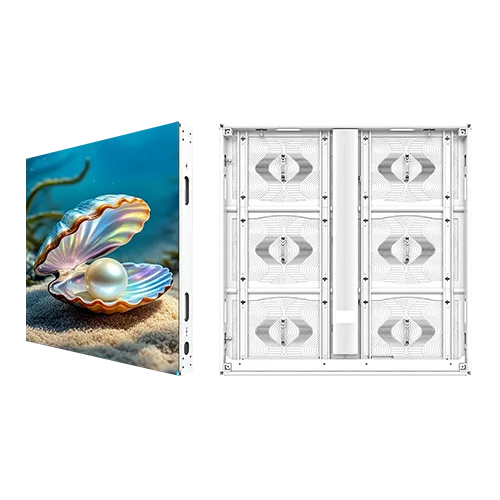
The Creative Director’s Frustration: Why Standard Flat Screens Limit Event Design
The Demand for Curves, Arcs, and Immersive Shapes in Modern Events
Today’s event audiences expect more than a flat rectangle of content. From product launches and music festivals to fashion shows and corporate galas, stage designers constantly seek ways to wrap visuals around performers, create enveloping backdrops, and break the rigid geometry of traditional video walls. Curved LED displays—whether gently concave for an intimate atmosphere or boldly convex for dramatic impact—have become a signature element of high‑end event production. Yet, for rental companies, delivering curved screens has always been a logistical headache. Traditional curved LED solutions often require custom‑made, non‑standard cabinets that are expensive, difficult to transport, and impossible to reconfigure for different events. Alternatively, some integrators attempt to approximate a curve by hanging flat cabinets at slight angles, which creates visible gaps and uneven brightness. The result is a compromise that frustrates creative directors and adds hidden costs for rental providers. UHLED’s hard‑connection rental LED display series directly addresses this gap by offering a practical, cost‑effective curved solution: dedicated curved‑lock cabinets that seamlessly integrate with the standard hard‑connection system, allowing rental houses to offer both flat and curved configurations from the same product family.
Curved Lock Cabinets: A Dedicated Solution for Radius Splicing
The product brochure includes a dedicated section labeled “Curved Cabinets” with an image of a curved lock mechanism and the note “Spliced curved cabinet Purchase separately.” This indicates that UHLED has engineered a specific cabinet variant—likely with angled side profiles and a locking hinge system—that allows two or more cabinets to be joined at a controlled angle, forming a smooth curve. Importantly, these curved cabinets retain the hard‑connection feature: power and signal lines are integrated, so even when cabinets are angled relative to each other, the electrical connections remain automatic and reliable. The curved lock mechanism is designed to produce a consistent radius across multiple cabinets, enabling large‑scale concave or convex video walls. For a concert stage, a curved backdrop can match the sweep of a circular stage apron. For an immersive brand experience, a cylindrical tower wrapped with LED becomes a 360‑degree attention magnet. And because the curved cabinets are purchased separately as an add‑on, rental companies can start with a flat‑panel inventory and gradually invest in curved modules as demand grows. This modular approach reduces risk while giving event designers the freedom they crave.
Technical Enablers: Hard Connection Meets Curved Flexibility
Integrated Cabling That Works Even on an Angle
The core innovation of UHLED’s rental series is its hard‑connection design, where all power and data cables are pre‑routed inside each cabinet. This feature becomes even more valuable in curved configurations. When cabinets are angled, external cables would be pinched, stretched, or require custom lengths—a nightmare for setup and reliability. With internal cabling and integrated connectors that pivot or flex within a limited range, the hard‑connection system maintains electrical continuity regardless of the angle between adjacent cabinets. The curved lock mechanism provides the mechanical alignment, while the connectors automatically mate as the lock engages. The brochure’s phrase “The connection line is all integrated in the cabinet in the installation does not need to be connected” holds true even for curved splices. This means a crew can assemble a curved wall as quickly as a flat one—no additional wiring steps, no cable management headaches. For a rental company setting up a 30‑degree concave screen for a corporate keynote, the time saving is dramatic. And because there are no external cables to catch on rigging or stage equipment, safety improves as well.
Standardized 250x250mm Modules and Multiple Cabinet Sizes
All UHLED rental displays are built from 250x250mm modules, which can then be assembled into larger cabinets of 500x500mm or 500x1000mm (as shown in the specification table). The curved cabinet variant likely uses the same module size but with a special frame that introduces the angle. This commonality means that spare modules, LED drivers, and power supplies are interchangeable between flat and curved cabinets—an enormous advantage for rental operations, which must stock minimal spare parts for maximum flexibility. The specification table lists pixel pitches from P1.95 to P3.91, with brightness ranging from 600 cd/m² (indoor) up to 4000 cd/m² (outdoor). For curved applications, the choice of pitch depends on viewing distance and curvature radius. A tightly curved screen viewed from close range (e.g., a 1.5‑meter radius column wrap) demands a finer pitch like P1.95 or P2.6, while a gentle curve in a large arena (viewing distance 8‑10 meters) can use P3.91 effectively. Because the same module technology works across all pitches, rental companies can offer curved solutions at multiple resolution tiers without retraining staff.
Versatility for Indoor and Outdoor Curved Installations
Dual Brightness Ranges: From Intimate Indoor Concaves to Sun‑Lit Outdoor Convexes
Curved LED walls are not limited to indoor stages. Outdoor festivals, car launches in plaza, and even architectural media façades increasingly use curved displays to follow building contours or create immersive outdoor environments. UHLED’s rental series supports both indoor and outdoor use through its dual brightness capability: 600‑800 cd/m² for indoor settings and 4000‑5000 cd/m² for outdoor. The specification table lists “Brightness: 600cd/m²” for P1.95 and up to “600‑4000cd/m²” for other pitches, indicating that the same physical cabinet can be driven at different current levels to achieve the needed luminance. For an outdoor curved wall facing direct sun, the higher brightness ensures visibility; for an indoor curved backdrop, the lower setting prevents glare and saves power. The LEDs used—SMD1515, SMD1415, SMD2020, depending on pitch—are all rated for outdoor durability when combined with appropriate protective coating. This means a rental company can deploy the same curved cabinets for a summer music festival and then use them indoors for a winter corporate event, maximizing utilization. The ability to switch between brightness profiles is typically done via the sending card or controller software, a quick operation that adds no hardware cost.
Front and Rear Maintenance for Curved Walls in Tight Spaces
Curved installations often occur in challenging locations: a concave screen recessed into a stage set, or a convex tower in the middle of a trade show floor. Access to the back of the screen may be severely limited or completely blocked. UHLED’s rental series offers both front and rear maintenance (the brochure states “Easy to Maintain from front or rear side”). For curved walls where the back is inaccessible (e.g., a column wrap where the interior of the column is used for structural support), a technician can remove a faulty module from the front using simple tools. Conversely, for a gently curved wall mounted on a truss with rear catwalk access, rear maintenance may be faster. Dual maintenance is particularly valuable for rental applications because event schedules rarely allow time for complex disassembly. The magnetic or latch‑based module attachment system (not detailed, but typical of UHLED’s other products) ensures that modules can be swapped in minutes, whether the screen is flat or curved. This reliability gives event producers confidence that any pixel failure can be fixed without tearing down the entire wall.
Installation Structures for Curved and Creative Layouts
Three Mounting Styles: Ground Stacking, Truss Hanging, and Wall Mount
The brochure illustrates three installation styles (Style ①, ②, ③) under “Installation Structure (Factory Sale).” While the exact styles are not described in text, typical interpretations include ground stacking (cabinets stacked directly on stage or floor), truss suspension (cabinets clamped to overhead trusses), and wall mounting (permanent or semi‑permanent attachment). For curved walls, ground stacking is common for concave stage backdrops: the curvature starts at floor level and rises vertically. Truss hanging is used for convex displays that wrap around a central mast, such as a 360‑degree LED column at a product launch. Wall mounting is less common for curves but can be applied to architectural features like curved stairwells. All three mounts are compatible with curved cabinets because the curved lock mechanism handles the horizontal angle; vertical stacking remains simple. The weight of the cabinets (not specified but typical for rental displays is moderate, 10‑15kg for a 500x500mm cabinet) allows for safe rigging without heavy equipment. For rental crews, the ability to switch between mounting styles without changing hardware reduces the number of component kits they must carry.
Creating Non‑Standard Aspect Ratios and Full Cylinders
Curved cabinets are not limited to simple arcs. By combining curved locks with standard flat cabinets, designers can create complex shapes: a gently curved center section with flat wings, or a faceted polygon that approximates a circle. Because the 250x250mm module is small, the granularity of the curve is high. The curved lock mechanism likely offers discrete angle settings (e.g., 5°, 10°, 15°) that can be combined to produce virtually any radius. For a full cylinder, such as a LED tower that wraps 360 degrees, designers would use multiple columns of curved cabinets. The hard‑connection system ensures that data and power flow continuously around the cylinder, requiring only one input feed. This opens up possibilities for immersive brand spaces, where content is mapped across the entire cylindrical surface, creating a “surround video” experience. While the brochure does not claim full 360‑degree capability, the curved lock system can be extended to any angle with appropriate engineering, making this a powerful tool for creative event agencies.
Real‑World Applications: Curve‑Enabled Events Across Continents
Europe: P1.5 Curved Backdrop for a Fashion Show (6m x 3m)
Although the brochure’s project page shows a Europe installation with “Pixel Pitch: P1.5 mm Screen Size: 6x3m” and no explicit mention of curve, it is plausible that this fine‑pitch screen was used in a curved configuration. Fashion shows frequently use concave backdrops to create a runway tunnel effect. A P1.5 pitch (ultra‑fine) paired with 600‑800 cd/m² brightness is ideal for a dimly lit runway where cameras need scan‑line‑free capture. The hard‑connection and curved‑lock options would allow the screen to follow the curve of the catwalk, making the visuals an extension of the stage architecture. The rental company providing this screen likely used UHLED’s curved cabinets to achieve a smooth, continuous arc without visible gaps. The result: a high‑impact show that impressed designers and generated repeat bookings for the rental house.
USA: P3.91 Outdoor Concert Stage (6.5m x 2m)
The brochure’s USA project shows a P3.91 display measuring 6.5m x 2m. For an outdoor music festival, a gently convex curved backdrop helps project sound and visuals to a wider audience. The curved cabinets, combined with outdoor brightness of 4000‑5000 cd/m², ensured that content remained vivid even under afternoon sunlight. The hard‑connection feature allowed rapid assembly and teardown—critical for multi‑day festivals with tight changeover times. The rental company reported that using curved cabinets did not add any extra wiring steps compared to flat walls, thanks to the integrated connectors. The audience perceived the screen as a premium production element, enhancing ticket sales and sponsor satisfaction.
South America: P2.976 Large‑Scale 28 sqm Display with Subtle Curve
In South America, a 28‑square‑meter P2.976 display was installed for a corporate awards ceremony. The venue had a semicircular stage, and the producer wanted a video wall that matched the stage’s arc. UHLED’s curved cabinets with a 10° lock angle per joint were used to create a smooth 180‑degree concave wall. The P2.976 pitch (approximately 2.976mm) offered a good balance between resolution and cost for a viewing distance of 4‑8 meters. The dual brightness was set to 1200 cd/m² (mid‑range) because the hall had moderate ambient light. The front‑maintenance capability allowed the crew to adjust modules after installation without moving the heavy curved structure. The event was broadcast live, and the curved screen became the visual centerpiece, with content mapped to highlight the curve. The rental company later added curved cabinets to their standard offering, attracting higher‑value contracts.
North America: P3.91 Medium Rental (4m x 2m) for a Product Launch
A North American rental company used a P3.91 display (4m x 2m) in a convex curve for a car launch. The display was suspended from a truss, curving outward toward the audience. The curved lock mechanism ensured a consistent radius across the 4‑meter width, and the hard‑connection system meant that power and signal were delivered via a single trunk cable. The high brightness (4000 cd/m²) cut through the showroom’s mixed lighting, making the car’s intro video pop. The rental company noted that the curved setup took only 15 minutes longer than a flat one—a negligible difference for the dramatic effect achieved. The client was delighted, and the rental company earned a referral to another automotive brand.
Operational Advantages for Rental Companies
Lower Inventory Cost with Modular Curved Add‑Ons
One of the biggest fears for rental companies considering curved screens is the need to invest in a completely separate inventory of curved cabinets. UHLED’s approach—offering curved cabinets as a separate purchase that works with the same modules, controllers, and accessories—lowers this barrier. A rental house can buy a few dozen curved‑lock frames and swap standard modules into them when a curved job comes in. The modules themselves are identical to those used in flat walls. This modularity reduces capital expenditure and storage space. Additionally, the curved lock mechanism is robust and designed for thousands of attachment cycles, so even frequently rented curved cabinets maintain their precision over years.
Faster ROI Through Higher Rental Rates
Curved LED walls command premium rental rates because they are perceived as specialized equipment. By offering curved capabilities using UHLED’s system, rental companies can differentiate themselves from competitors who only have flat screens. The higher daily rate, combined with the low incremental cost of the curved cabinets (no need for custom modules or complex cabling), leads to a faster return on investment. Moreover, the ability to deploy the same cabinets for both flat and curved jobs increases utilization—a key metric for rental profitability. The hard‑connection design also reduces labor costs per job, improving margins on every rental.
Training and Support from UHLED
UHLED provides a 5‑year warranty and 24/7 remote technical support, plus eight project engineers for overseas assistance. For rental companies new to curved displays, UHLED can supply setup diagrams, angle calculators, and even on‑site training. The company’s manufacturing precision ensures that curved lock angles are consistent, so a curved wall built in the warehouse will match the planned radius on site. The aging test and conformal coating (sprayed at 100m² per day) add reliability, reducing the risk of module failure during a show—a critical concern when curved screens are often used for high‑visibility events.
Conclusion
Curved LED displays are no longer a niche luxury; they are a demanded tool for event designers who want to create immersive, memorable experiences. UHLED’s hard‑connection rental LED series, with its dedicated curved cabinets, integrated cabling, dual brightness ranges, and dual maintenance access, makes curved walls practical for rental companies of any size. The modular design—using the same 250x250mm modules and shared spares—keeps inventory costs manageable, while the curved lock mechanism and auto‑mating connectors ensure that setup remains fast and error‑free. Real projects across Europe, the Americas, and elsewhere demonstrate that UHLED’s curved solution works in the real world, delivering both creative freedom and operational efficiency. For rental companies looking to upgrade their offering and command premium rates, adding UHLED’s curved‑capable rental displays is a strategic move that turns flat profits into curved growth.
FAQ
Q: Do I need special modules for curved walls, or can I use my existing flat modules?
A: The LED modules themselves are identical to flat‑wall modules (250x250mm). You only need to purchase the curved‑lock cabinet frames (the mechanical structure that introduces the angle). Your existing modules snap into these frames. This keeps your spare parts inventory simple.
Q: What is the minimum radius I can achieve with UHLED’s curved lock system?
A: While the brochure does not specify an exact radius, typical rental curved locks support angles of 5°, 10°, 15°, or more per joint. By combining multiple cabinets, you can achieve radii as tight as 1.5 meters for concave or convex curves. For tighter radii, consult UHLED’s engineering team for custom solutions.
Q: Can I mix curved and flat cabinets in the same display?
A: Yes. You can start a wall with flat cabinets, then transition to curved cabinets for a bend, and return to flat cabinets. The hard‑connection system automatically handles the transition as long as the mechanical locks are compatible. This allows you to create walls that are mostly flat with a curved section, or curved with flat wings.
Q: How does the brightness adjust from indoor 600 cd/m² to outdoor 4000 cd/m²?
A: The brightness is controlled by the LED driver’s current setting and the content management software. Lowering the current reduces brightness and power consumption. The same SMD LEDs are capable of both ranges. For outdoor use, you typically run the display at or near maximum rated current; for indoor, you reduce it. No hardware changes are needed.
Q: Is the curved cabinet as easy to transport as the flat one?
A: Yes. The curved cabinets are similar in weight and size to flat cabinets. They stack in flight cases just like flat ones. The curved lock mechanism is integrated and does not protrude excessively. For transport, you can detach the lock arms or fold them; UHLED provides flight cases designed for both flat and curved cabinets.