The Overlooked Metrics: Why Contrast and Viewing Angle Matter as Much as Resolution
Fine Pitch Is Only Half the Story
When specifying an indoor LED display for a high‑end boardroom, executive briefing center, or telepresence suite, buyers typically focus on pixel pitch – P1.25, P1.56, P0.93 – assuming that finer pixels automatically guarantee better image quality. While resolution is important for sharpness and text legibility, it does not address two critical factors that determine whether an image looks “premium” or “flat”: contrast ratio and viewing angle. A high‑resolution display with mediocre contrast will produce washed‑out blacks and dull highlights, robbing content of depth and making the screen look like an over‑brightened laptop. A display with narrow viewing angles will force executives sitting at the ends of a long table to see faded, color‑shifted images, undermining the collaborative purpose of a shared video wall. UHLED’s indoor COB series addresses both dimensions with specifications that are rarely found together in competing products: contrast ratios of up to 6000:1 (for P1.25, P1.56, P1.87) and viewing angles of H160°/V160° across all pitches. The brochure lists these numbers plainly – “Contrast Ratio 6000:1” and “View Angle H160°/V160°” – but their practical implications for premium indoor environments deserve a deeper examination. This article explores how high contrast and wide viewing angles transform a fine‑pitch COB display into a truly immersive, collaborative canvas where every seat is the best seat and every image carries cinematic depth.
COB Technology’s Inherent Contrast Advantage Over SMD
Contrast ratio measures the difference between the brightest white and the darkest black a display can produce. For LED displays, contrast is heavily influenced by the blackness of the background between pixels. Traditional SMD (surface‑mounted device) LEDs are individual packages mounted on a PCB; the gaps between them are filled with reflective solder mask and white or green substrate, which scatters ambient light and raises black levels. COB (chip‑on‑board) technology, by contrast, encapsulates the LED chips under a single dark protective layer. The brochure describes COB as “chip‑level packaging eliminates the pixel graininess,” but the same packaging also absorbs ambient light, making the non‑emitting areas of the screen appear truly black. The result is a native contrast ratio of 6000:1 for the larger pitches – about twice what typical high‑end SMD displays achieve. This means that in a boardroom with controlled lighting, a COB display can show a night sky scene where the black areas are deep and uniform, and a white slide appears crisp without blooming. When displaying financial charts with dark backgrounds or architectural renderings with shadow details, the high contrast preserves nuance that would otherwise be lost. For companies that present visual‑heavy content – product mockups, data visualizations, video clips – this contrast advantage directly impacts the professionalism of the presentation.
Deconstructing 6000:1 Contrast: Real‑World Benefits for Indoor Professional Environments
Reading Fine Text and Detailed Graphics Without Eye Strain
In a boardroom, much of the content is text‑based: PowerPoint slides, spreadsheets, legal documents, and engineering drawings. On a low‑contrast display, black text appears as dark gray against a light background, forcing viewers to squint or lean forward. On a 6000:1 contrast display, black text is intensely black, while the white background remains bright but not blown out. The result is exceptional legibility even at small font sizes. For a P1.25 COB wall viewed from 2.5 meters, 10‑point text is perfectly readable without any artificial sharpening. The 13‑bit gray level (8192 steps per color) works in concert with the high contrast to ensure that anti‑aliased text – the slight smoothing around character edges – appears smooth, not jagged. This reduces eye strain during long meetings, which is a documented benefit for participants who spend hours reviewing dense documents on the main display. Facilities managers have noted that after switching from a lower‑contrast SMD wall to UHLED’s COB, meeting attendees complained less about “screen fatigue” and were able to focus longer.
Preserving Detail in Shadows and Highlights for Video and Imagery
Video content – whether a corporate brand film, a product demo, or a remote video feed – contains a wide range of luminance. A low‑contrast display crushes shadows into muddy blacks and clips highlights into featureless white patches. A 6000:1 display preserves detail in both extremes. For example, a scene shot in a dimly lit factory floor will still show textures in the dark corners, while an outdoor shot with a bright sky will retain cloud formations and subtle blue gradients. The 13‑bit gray depth ensures that the transition from dark to light is smooth, with no visible banding. For a luxury brand presenting a new product video, this fidelity conveys quality and attention to detail. For a security or monitoring room displaying camera feeds, high contrast can mean the difference between seeing a person in the shadows and missing them entirely. UHLED’s COB series, with its contrast ratio exceeding that of many commercial LCD monitors, brings a level of visual depth that makes any content look more engaging and professional.
How Contrast Interacts with Ambient Light: The Importance of a Dark Panel Surface
Boardrooms rarely have perfect lighting. Sunlight from windows, overhead spotlights, and light from table lamps all fall on the screen. A glossy or reflective panel surface would wash out blacks under ambient light. COB’s matte, dark encapsulation layer absorbs stray light rather than reflecting it. This means that even with the room lights at 300‑500 lux (typical for a working boardroom), the display maintains much of its contrast. The brochure’s brightness spec of 600 cd/m² (after calibration) is sufficient to overcome ambient light without needing to dim the room to cave‑like darkness – allowing participants to take notes, read documents, and see each other clearly. This combination of high contrast and adequate brightness makes the COB display suitable for “lights‑on” presentations, a common requirement in modern offices where video conferencing cameras need to capture faces, not silhouettes.
Wide Viewing Angle: Every Seat, Perfect Image
The Problem of Narrow Viewing Angles in Traditional LED Displays
Many indoor LED displays, especially those using older SMD designs or certain driver technologies, exhibit a sharp drop in brightness and color accuracy when viewed from an angle beyond 60°. Executives seated at the ends of a long conference table – which can be 6‑8 meters wide – may view the screen at angles of 70° or more. On a narrow‑angle display, the image becomes dim, colors shift toward blue or red, and fine text becomes unreadable. This creates an unequal meeting experience: the person in the center sees a perfect image, while those at the periphery feel excluded. For collaborative decision‑making, this is unacceptable. UHLED’s COB series specifies a viewing angle of H160° / V160° – meaning that the image remains consistent up to 80° left or right from the center, and 80° up or down. This is essentially a “half‑sphere” of good viewing. In practice, for a 3‑meter‑wide video wall viewed from a 2‑meter distance, the most extreme seat angle is about 65° – well within the 160° specification. The result is that every participant sees the same vibrant, legible image, fostering equality and focus.
How COB Enables Wide Viewing Angles: Optics of Encapsulation
Wide viewing angles are not automatic with fine pitch. SMD displays often have directional light output because each lamp bead acts as a tiny spotlight with a limited lens. COB’s encapsulation layer diffuses light more uniformly, creating a wider, softer emission pattern. The brochure’s “COB Inverted Chip Technology” eliminates the individual lenses of SMD, resulting in a more Lambertian (even in all directions) light distribution. This is why COB displays are favored for applications where many viewers sit at off‑axis positions, such as large conference rooms, lecture halls, and broadcast studios. The 160° horizontal angle means that even a viewer sitting almost parallel to the screen’s plane can still read content – though in practice, furniture placement rarely exceeds 80°. For a classroom with rows of seats, the vertical viewing angle of 160° ensures that students in the front row (looking up) and those in the back (looking down) all see the same brightness and color.
Color Uniformity Across the Wall and Across the Room
Wide viewing angle is not only about brightness but also about color accuracy. On inferior displays, a white slide viewed from an angle may turn pink or green. UHLED’s COB maintains color consistency across the full 160° range, which is critical for brand‑sensitive content where logo colors must be exact. The 13‑bit gray level and precise calibration of each module further ensure that color does not shift. For a multinational corporation displaying its brand palette on the main wall, the assurance that every executive sees the same blue is a subtle but important trust signal. For video conferencing, where the remote participants see the wall via a camera that is often positioned off‑center, wide angle ensures that the camera captures a uniform image without color fringing.
Complementary Features That Amplify the Visual Experience
3840Hz Refresh Rate: No Flicker, No Scan Lines, Even at Wide Angles
Refresh rate and viewing angle are independent but complementary. A high refresh rate like 3840Hz eliminates flicker that can cause eye strain, and it also eliminates scan lines when the display is photographed or recorded. For a boardroom that uses video conferencing (where a camera points at the screen as a backdrop for speakers), scan lines would be distracting to remote viewers. Because UHLED’s COB has 3840Hz refresh, even a camera positioned at a wide angle (shooting from the side) will not pick up moving bars. The fanless design ensures that the camera’s microphone does not pick up fan noise – a common problem with cooled SMD displays. All of these features, combined with high contrast and wide angle, make the COB display a comprehensive solution for premium AV environments.
13‑Bit Gray Level: Smooth Gradients from Any Angle
Gray depth affects how smooth color transitions appear, especially in large areas of subtle change – like a gradient background on a slide. At 13 bits, there are 8192 steps per color channel. When viewed from an angle, some displays introduce banding because the perceived brightness steps become coarser. UHLED’s COB maintains the 13‑bit fidelity across the entire viewing cone because the encapsulation layer does not create angle‑dependent artifacts. This means that a slide with a soft blue gradient will look perfectly smooth to the person sitting at 70° off‑axis, just as it does to the center viewer. For design‑driven companies, this attention to detail reinforces their brand standards.
Ultra‑Thin 32mm Cabinet and Magnetic Front Maintenance: Preserving the Clean Aesthetic
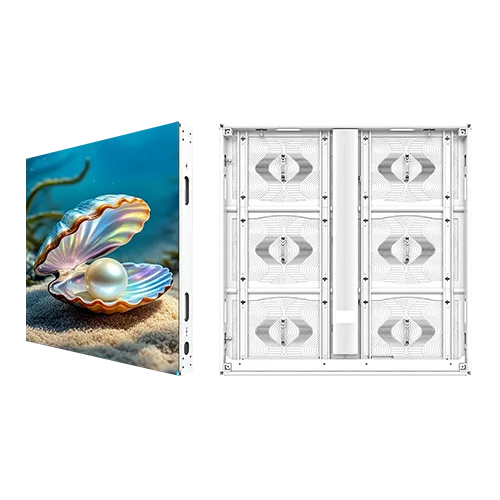
High image quality deserves a housing that doesn’t distract. The 32mm thin cabinet (weighing only 2.1kg) allows the display to be mounted flush with the wall, becoming almost invisible when not in use. The magnetic front maintenance tool enables module swaps without rear access, so the wall can be installed against any surface without a service corridor. This is particularly valuable in boardrooms where the display is recessed into a wood panel or mounted on a glass wall. The screwless design (mentioned under seamless splicing) ensures that the front surface is smooth and uncluttered, with no visible fasteners. The die‑cast aluminum structure provides the flatness needed to maintain the 0.1mm seam tolerance, which is essential for the illusion of a single continuous canvas. When you combine all these – high contrast, wide angle, seamless flatness, and unobtrusive installation – the result is a display that commands attention only when it is on, and disappears when it is off.
Real‑World Scenarios Where Contrast and Viewing Angle Make the Difference
The Global Law Firm: Presenting Evidence with Integrity
A global law firm installed a P1.56 UHLED COB wall (6000:1 contrast) in its main moot court room. During a practice trial, a partner displayed a surveillance video that contained crucial shadow details. On the firm’s previous SMD wall, the shadow was a black blob. On the COB wall, the outline of a person’s face was visible, leading to a successful mock argument. The wide viewing angle meant that the three judges sitting at the bench (spread across a 4‑meter width) all saw the same detail without moving. The firm has since standardized on UHLED COB for all its major conference spaces.
The European Investment Bank: Displaying Complex Charts
A large financial institution uses a P1.25 COB wall (P1.25, 6000:1) in its main trading floor analysis room. Traders and analysts sit in a semicircle around the wall, with angles ranging from 0° to 75°. The wide viewing angle ensures that every analyst sees the same color coding on complex bond charts – a misinterpretation due to color shift could cost millions. The high contrast makes the small text on spreadsheets crisp and readable. The 3840Hz refresh prevents flicker from the overhead fluorescent lights (some countries use magnetic ballasts that cause flicker on lower‑refresh displays). The facility manager reports zero complaints about screen visibility since installation.
The Asian Broadcast Studio: On‑Camera Perfection
A television studio in the Philippines (the project shown in the brochure, P1.25, 4.8m x 3.04m) uses the COB wall as a news backdrop. The studio lights create a bright environment, and the camera is often positioned at 30‑40° off‑center to frame the anchor. The wide viewing angle ensures that the backdrop remains uniform and free of color shift. The high contrast allows the anchor’s dark suit to stand out from a dark background – a common challenge with lower‑contrast screens. The 3840Hz refresh eliminates scan lines, and the fanless design keeps audio clean. The studio director noted that the COB wall “looks like a high‑end OLED” but with the brightness and reliability needed for 18‑hour broadcast days.
The African Government Conference: International Meetings
In Africa, a P1.25 COB wall (1.8m x 1.01m) is used in a conference room that hosts delegations from multiple countries. Participants sit around a long U‑shaped table, with the farthest seats at about 70° from the screen center. The wide viewing angle ensures that every delegate, regardless of seat, sees the same slide content without distortion. The high contrast makes translated subtitles (often in white on dark background) legible. The magnetic front maintenance allowed a local technician to replace a module damaged by a bumped tripod in under five minutes, without moving the massive table or calling for specialized service. The room’s AV lead praised the combination of image quality and serviceability.
Manufacturing Excellence That Guarantees Consistency
Precision Placement and Aging Test
UHLED’s Panasonic MSR and Samsung S2 placement machines ensure that each of the millions of COB chips is placed with micron accuracy. The conformal coating (100m² per day) protects against humidity, and the aging test burns in every module before shipping. This manufacturing rigor guarantees that the 6000:1 contrast and 160° viewing angle are not just theoretical but realized in every cabinet.
5‑Year Warranty and Global Engineering Support
UHLED offers a 5‑year warranty covering the COB modules, power supplies, and controllers. Eight project engineers provide 24/7 remote support and can assist with on‑site calibration to ensure that contrast and viewing angle are optimized for the specific room geometry. For large international projects, this support gives integrators and end users confidence.
Conclusion
In the world of premium indoor LED displays, pixel pitch gets the headlines, but contrast ratio and viewing angle do the heavy lifting of creating a truly engaging, equitable viewing experience. UHLED’s indoor COB series delivers up to 6000:1 contrast – deep blacks, bright whites, and shadow detail that makes content pop – and 160° horizontal and vertical viewing angles that put every seat in the room on equal footing. These specifications, combined with 3840Hz refresh, 13‑bit grayscale, fanless silent operation, and a 32mm thin, front‑maintainable die‑cast aluminum cabinet, make the COB display the ideal choice for boardrooms, broadcast studios, command centers, and any environment where image quality and viewer comfort are paramount. Real projects across Africa, Israel, and the Philippines prove that UHLED’s COB series delivers on its promises. For decision‑makers who want a display that impresses not just with sharpness but with depth, uniformity, and inclusivity, UHLED’s COB series is the clear choice.
FAQ
Q: What is the real‑world contrast ratio of SMD vs. COB in typical boardroom lighting?
A: In a room with 300 lux ambient light, a high‑end SMD display may achieve an effective contrast of 800‑1000:1 because ambient light reflects off the PCB gaps. COB’s dark encapsulation absorbs ambient light, maintaining an effective contrast of 3000‑4000:1. The difference is visually obvious: blacks look black, not dark gray.
Q: Does the viewing angle of 160° mean I can see the screen from the side of the room?
A: Yes. Even if you are seated almost parallel to the screen’s plane (e.g., 80° off‑center), you will still see a usable image. However, for critical tasks like reading small text, we recommend staying within 70° of center. For general video and slides, the full 160° is acceptable.
Q: How does the contrast ratio change with different pixel pitches?
A: The brochure lists 6000:1 for P1.25, P1.56, and P1.87, and 5500:1 for P0.78 and P0.93. The slightly lower contrast on the finest pitches is due to the smaller black area between pixels, but 5500:1 is still excellent. All models outperform typical SMD displays.
Q: Can I calibrate the display to improve contrast further?
A: Yes. UHLED provides calibration software that adjusts gamma curves and color balance. However, the native contrast is fixed by the COB design. Calibration can optimize the display for specific content types (e.g., cinema mode for video, text mode for presentations).
Q: Is the 160° viewing angle maintained after the display is mounted flush in a wall niche?
A: Yes, as long as the niche does not create a physical obstruction that blocks the extreme angles. The display’s optical performance is independent of the mounting. For recessed installations, ensure the bezel or frame does not shadow the edges of the screen at wide angles. UHLED’s engineering team can review your architectural plans.