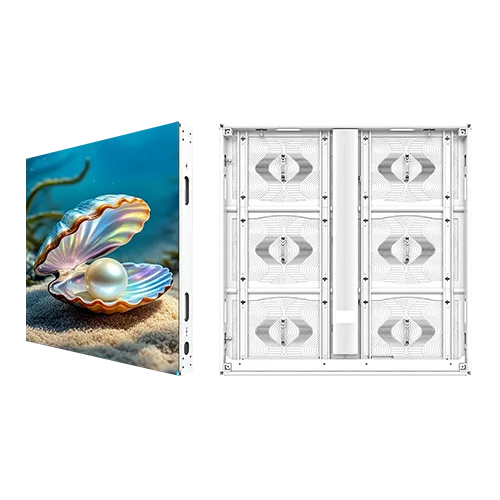
Outdoor COB LED Display
Full Flip Chip COB LED Display — P1.56 & P1.95 — IP65 Waterproof


The commercial display market is undergoing a major shift away from bulky legacy panels. In this post, we will break down how next-generation COB LED display technology operates, compare it with SMD packaging, and explore its massive performance benefits.
COB LED, or chip on board light-emitting diode, is an integrated semiconductor packaging architecture where multiple bare RGB micro-chips are bonded directly onto the surface of a printed circuit board (PCB) to form a single, unified display module. By completely eliminating the individual plastic housings and lead frames found in traditional surface-mount designs, this packaging method creates a 100% flat, continuous, and high-density pixel matrix.
To understand how a COB LED display works at a hardware level, we must look at its physical integration. Instead of soldering pre-packaged components onto the board, the assembly relies on direct chip attachment and advanced encapsulation.
Traditional display packaging relies on bulky housings. This limits how close pixels can be placed to one another. By eliminating these individual physical shells, COB LED technology allows manufacturing engineers to tightly pack millions of micro-diodes into a highly condensed footprint. This makes ultra-fine pixel pitches (under P1.0mm) achievable and scalable for premium viewing experiences.

The architectural advantages of COB LED technology translate directly into superior performance metrics that legacy commercial panels cannot match.
Pixel pitch represents the center-to-center distance between two adjacent pixels. The tighter the pitch, the higher the pixel density per square meter. Because COB technology can leverage microscopic flip-chips down to the micrometer level, it comfortably achieves pixel pitches of P0.9, P0.7, and even lower.
This enables native 4K or 8K resolutions within a highly compact boardroom wall footprint. Viewers can stand directly in front of the screen without experiencing pixelation or the “screen-door effect,” significantly reducing the minimum comfortable viewing distance.
A standard SMD panel often scores an Ingress Protection rating of just IP20 or IP30, meaning it has zero resistance to liquids and can easily collect dust inside its housing.
COB display surfaces achieve a native IP54 or higher front-side protection rating. The robust polymer encapsulation forms an airtight shield that repels moisture, dust, and static electricity. This robust protection offers massive peace of mind for high-traffic environments like university lecture halls, public transit hubs, and corporate lobbies.
Heat is the primary enemy of LED longevity and color uniformity. In an SMD setup, heat generated by the LED die must travel through an internal lead frame and an outer solder pad before reaching the aluminum cabinet backing. This creates thermal bottlenecks.
COB chips are adhered directly to the core PCB, allowing heat to dissipate straight through the display frame. This superior thermal transfer lowers the operating temperature of the junction diode, slowing down color shifts and diode degradation while drastically reducing long-term energy consumption.
Traditional SMD packaging uses reflective plastic sidewalls that narrow the effective viewing angle, causing noticeable color shifts or brightness drops when viewed from the side.
Advanced COB LED displays (especially those employing flip-chip configurations) distribute light evenly across a 170-degree viewing angle both horizontally and vertically. Combined with a higher contrast ratio that outputs deep, pure black levels, COB technology ensures crisp text legibility and vibrant color uniformity from any seat in the venue.
To understand why a COB LED display commands premium positioning in the market, it is essential to analyze the engineering differences between COB and the legacy Surface Mounted Diode (SMD) packaging standard.
| Technical Parameters | Legacy SMD LED Displays | Next-Gen COB LED Displays |
| Physical Construction | Soldered plastic cups with internal bonding wires | Bare semiconductor chips bonded directly to PCB |
| Component Size Limits | Restricted to sizes due to lead frames | Micro-scale components down to a few micrometers |
| Pixel Pitch Capability | Typically limited to due to solder bridging | Easily achieves ultra-fine pitches () |
| Surface Physical Profile | Grainy, granular pixel textures; fragile to impacts | 100% flat, continuous, high-gloss protective shell |
| Ingress Protection (IP) | Typically IP20 to IP30 (Exposed component pads) | IP54 to IP65 (Fully sealed front matrix) |
| Thermal Dissipation Pathway | Chip Lead Frame Solder Pad PCB | Chip Adhered Substrate directly to PCB |
SMD screens rely heavily on surface-mount reflow soldering. Every individual SMD pixel requires multiple independent solder pads to anchor it to the PCB. In a giant 4K video wall, this equates to tens of millions of micro-solder points.
If heat cycling causes the PCB to expand, or if there is inaccurate pressure during manufacturing, these solder joints develop micro-fractures. COB technology removes these fragile surface solder joints entirely, eliminating the number-one cause of pixel blackouts and dead lamps.
Because SMD diodes stick out as small, isolated blocks on the front of a display screen, they are highly vulnerable to physical collisions—such as a vacuum cleaner hitting a low wall module or a person bumping into the screen corner.
Furthermore, moisture and airborne dust can easily penetrate beneath the SMD casing, corroding the underlying copper contacts. COB displays are completely shielded by an impact-resistant epoxy matrix. This layer absorbs mechanical impacts and blocks moisture, rendering the screen completely safe to touch and wipe clean.
While COB technology offers unmatched engineering specifications, it is a premium investment designed for scenarios where visual precision and absolute uptime are mission-critical.
Chip-on-Board (COB) LED technology is no longer just a conceptual innovation; it is the modern standard for high-end indoor commercial displays. By bypassing the physical boundaries of legacy surface-mount soldering, COB unlocks pixel densities capable of true 4K resolution at close viewing distances, while providing unprecedented physical protection against water, dust, and mechanical impacts. For enterprises looking to future-proof their visual communication assets and achieve a lower total cost of ownership (TCO) through reduced maintenance costs, investing in a premier COB LED display is the ultimate choice.
Need Engineering Specifications for Your Next Screen Upgrade? Request an engineering consultation and custom solution quotation.
COB (Chip-on-Board) defines the packaging methodology—mounting bare chips directly onto the substrate board. Micro LED defines the size of the LED chip itself (typically chips smaller than 100 micrometers). Many high-end indoor screens on the market utilize COB packaging techniques to arrange and protect Micro LED chips, meaning the two terms often complement each other in advanced display specifications.
No, it is highly serviceable. While individual bare chips cannot be easily unsoldered on-site, modern commercial COB displays utilize advanced modular engineering. If an internal circuit error occurs, a field technician can use a specialized magnetic extraction tool to remove the palm-sized COB module and swap in a calibrated replacement from the original manufacturing batch in under a minute.