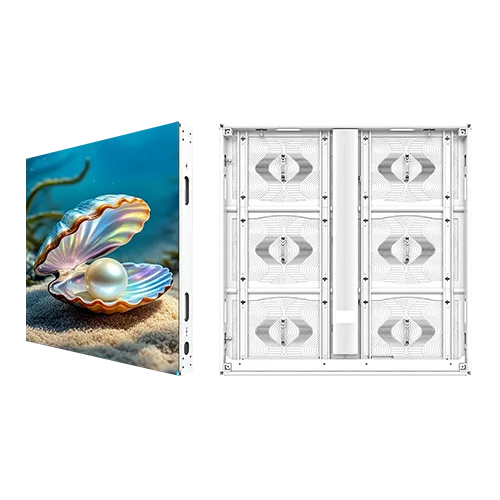
COB vs MIP (Micro LED in Package): Key Differences and How to Choose in 2026
The LED display industry is witnessing a technological revolution in 2026. As the demand for higher resolution, finer pixel pitches, and superior image quality grows, two packaging technologies have taken center stage: COB (Chip on Board) and MIP (Micro LED in Package). Understanding their differences is crucial for making the right investment decision.
What is COB LED?
COB (Chip on Board) is a mature packaging technology where LED chips are directly mounted onto a printed circuit board (PCB) and encapsulated with a protective coating. COB has become the mainstream choice for fine-pitch indoor displays, especially below P1.2 pixel pitch. Its integrated, seamless surface eliminates visible pixel borders, providing superior visual quality and excellent protection against environmental factors.
What is MIP (Micro LED in Package)?
MIP (Micro LED in Package) is a newer packaging technology that bridges the gap between traditional SMD/COB and true Micro LED. In the MIP process, Micro LED chips are first packaged into individual “matrix units” using a dedicated packaging line, then these units are assembled onto the display module. This approach combines the mass-transfer efficiency of Micro LED manufacturing with the proven quality control of traditional packaging processes.
Key Differences Between COB and MIP
1. Manufacturing Process
COB mounts LED chips directly onto the final PCB and encapsulates them on-site. MIP pre-packages Micro LED chips into modules on a dedicated packaging line before assembling them onto the final PCB. This gives MIP a distinct quality control advantage—each micro-package can be tested individually before final assembly, reducing rework costs.
2. Pixel Pitch Capabilities
Both COB and MIP can achieve fine pixel pitches down to P0.6 and below. However, MIP is inherently more scalable for ultra-fine pitches (P0.3–P0.6) because its modular packaging approach allows for tighter chip integration. COB faces greater challenges below P0.6 due to yield rate issues.
3. Visual Performance
COB displays already offer excellent contrast, wide viewing angles, and seamless surfaces. MIP takes this further with even smaller light-emitting surfaces and higher contrast ratios. MIP’s micro-scale packaging enables deeper blacks and more vibrant colors, approaching the visual quality of true Micro LED.
4. Reliability and Protection
COB offers robust protection with its full-surface encapsulation, making it highly resistant to moisture, dust, and impact. MIP, while benefiting from individual package-level testing, still requires careful module-level protection. In demanding indoor environments (humidity, temperature fluctuations), COB’s proven reliability remains a strong advantage.
5. Cost and Maturity
COB technology has matured significantly over the past several years, with established supply chains and manufacturing processes that yield competitive pricing. MIP, being newer, is currently at a cost premium due to lower production volumes and the additional packaging step. However, MIP costs are expected to decrease as production scales up through 2026 and 2027.
Major Manufacturers in 2026
Leading LED display manufacturers have placed their bets on both technologies. Companies like Leyard, Unilumin, Absen, and InfiLED have mature COB product lines. Meanwhile, industry giants such as Samsung, Sony, and BOE are pushing MIP adoption for ultra-high-end applications. Many manufacturers now offer both technologies to serve different market segments.
How to Choose in 2026
Choose COB if:
- You need pixel pitches between P0.6 and P1.5
- Proven reliability and long-term stability are your top priorities
- Your budget requires a cost-effective fine-pitch solution
- You are deploying in environments with humidity or dust exposure
- You want a mature, well-supported technology with fast delivery
Choose MIP if:
- You demand ultra-fine pixel pitches below P0.6
- Maximum contrast and image quality are non-negotiable
- You are investing in a future-proof solution for flagship projects
- Your project budget allows for the premium cost of emerging technology
- Performance is prioritized over time-to-market and supply chain stability
Conclusion
In 2026, both COB and MIP are shaping as viable, high-performance options for fine-pitch LED displays. COB remains the safe, mature, and cost-effective choice for the majority of indoor applications, particularly in the P0.6–P1.5 range. MIP represents the bleeding edge, offering superior performance potential at ultra-fine pitches for flagship installations where budget is less of a constraint.
As the industry transitions toward true Micro LED in the coming years, MIP serves as an important stepping stone. For most buyers today, COB offers the best balance of performance, reliability, and cost. But for those who need the absolute best in image quality at ultra-fine pitch, MIP is the technology to watch—and to invest in.
Looking ahead, the LED display market is expected to converge further. By 2027–2028, advancements in Micro LED mass-transfer technology may eliminate the need for MIP’s intermediate packaging step entirely, bringing true Micro LED displays to mainstream applications. Until then, COB and MIP will coexist as complementary solutions serving different market segments and project requirements.
Why Choose UHLED?
At UHLED, we specialize in manufacturing high-performance LED display solutions tailored for global markets. Our product portfolio covers the full spectrum of SMD, GOB, and COB technologies, ensuring we can recommend the most suitable technology for every project requirement.
We pride ourselves on delivering premium quality at competitive prices, backed by rigorous quality control standards and a dedicated R&D team that continuously drives innovation. Our COB series, in particular, has been widely adopted in control rooms, corporate boardrooms, retail environments, and broadcast studios around the world.
Whether you need a cost-effective SMD solution for outdoor advertising or a high-end COB display for critical indoor installations, UHLED combines cutting-edge technology with dependable after-sales support to help you get the most out of your investment.