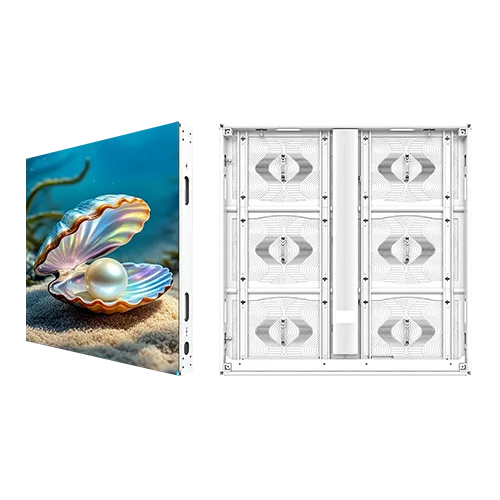
The Maintenance Nightmare of Conventional Outdoor LED Displays
When a Single Failed Module Brings Down the Entire Wall
Outdoor LED displays are exposed to harsh elements: rain, dust, temperature extremes, and sometimes vandalism. Even with the most robust engineering, individual modules or power supplies may eventually need replacement. In conventional outdoor displays, the maintenance design often forces a painful choice: either the screen is accessible only from the rear, requiring a service corridor or a crane to remove the entire cabinet; or it is accessible only from the front, but with complex latch mechanisms that are difficult to operate at height. For a billboard mounted on a highway gantry or a building façade, rear access may be impossible because the back of the screen is against a wall or a structural column. In such cases, a single failed module can mean that the entire wall must be partially disassembled, or that a costly cherry picker must be rented to reach the front – and even then, the repair may take hours because the module cannot be released without removing adjacent cabinets. The downtime translates directly into lost advertising revenue or, for public information displays, a failure to communicate critical messages. UHLED’s full aluminum outdoor display series solves this problem with a dual‑maintenance design that allows modules to be removed from either the front or the rear, using simple T‑type tools. The brochure states: “Maintenance Mode Both front and rear can be maintained,” with diagrams showing modules being removed from the front and the power cabinet from the rear. This flexibility is not a minor convenience; it is a strategic feature that reduces service costs, minimizes downtime, and extends the productive life of the display.
The Cost of Limited Access: Service Corridors, Lifts, and Labor
Installing a rear‑access‑only outdoor display forces the integrator to leave a service corridor of at least 0.6‑1 meter behind the screen. On a building façade, this may require sacrificing rentable interior space or designing an expensive cantilevered mounting system. For column‑mounted displays, rear access may be impossible altogether. When repairs are needed, a rear‑access screen demands that a technician physically go behind the wall – which may be blocked by other equipment, wiring, or structural elements. In many cases, the only practical solution is to remove the entire cabinet from the front, a heavy and risky operation. UHLED’s dual‑maintenance design eliminates these obstacles. If the rear is accessible, the technician can swap a module from behind in minutes. If the rear is blocked, the same module can be extracted from the front using the magnetic or T‑type tool. The brochure’s accessories list includes a “sleeve piece, key, t‑type equipment for front and rear maintenance,” confirming that the tools are standard and easy to use. For the display owner, this means lower lifetime maintenance costs: no need for expensive lift rentals for every minor repair, no need to maintain a service corridor that consumes valuable real estate, and no need to schedule repairs around crane availability. The 77mm thin profile and 24.5kg light weight further assist maintenance – a single technician can handle a module replacement without mechanical assistance.
Technical Design for Dual Maintenance: Modules and Power Supply
Front Module Removal: Magnetic or T‑Type Tool for Quick Access
The brochure’s maintenance diagram shows a technician using a tool to remove a module from the front of the cabinet. While the specific mechanism is not detailed, the presence of “t‑type equipment” indicates a purpose‑designed tool that engages with the module’s locking system. Typically, such tools either use a magnetic grip (similar to UHLED’s indoor COB magnetic tool) or a mechanical twist‑lock. The technician inserts the tool into the module, turns or presses, and pulls the module straight out. Because the cabinet is only 77mm deep, the module depth is shallow, and the connectors are designed for many insertion cycles. The front removal process takes less than one minute per module. For a roadside billboard, a technician in a bucket truck can replace a faulty module without needing to access the rear or remove neighboring cabinets. This capability is especially valuable for displays mounted on building walls where the rear is an interior office space that cannot be disturbed. The brochure’s “Maintenance Mode” section explicitly shows modules being removed from the front, reinforcing that this is a primary design feature, not an afterthought.
Rear Module and Power Supply Access for Rapid Servicing
When rear access is available – for example, on a freestanding column with a service platform or on a wall that backs onto a maintenance hallway – rear maintenance is often faster. The technician can open the rear cover of the cabinet, disconnect the module from behind, and push it out. The power supply cabinet is also accessible only from the rear, according to the brochure: “Power cabinet rear maintenance.” This is logical because power supplies are larger and typically located in a dedicated rear compartment. By separating module access (front/rear) from power supply access (rear), UHLED ensures that the most frequently replaced components (modules) can be serviced from either side, while the less frequently replaced power supplies are serviced from the rear. This design balances accessibility with security, as the rear cover can be locked to prevent tampering. For a display in a public area, the ability to lock the power compartment while still allowing front module access is a security advantage. The accessories include a key, which likely opens the rear door. For a fleet of displays, a standardized key and T‑tool simplify training and spare parts management.
Why Dual Maintenance Is Essential for Curved and Right‑Angle Splicing
When displays are installed in curved configurations (up to 80° arc) or at right‑angle corners, rear access becomes even more restricted. The inner curve of a concave screen may be entirely inaccessible because the cabinets angle inward, blocking any service corridor. The outer curve of a convex screen may be difficult to reach from the rear because the mounting structure is complex. In these scenarios, front maintenance is the only viable option. UHLED’s dual‑maintenance design ensures that even the most creative architectural installations remain serviceable. The brochure’s curved and right‑angle splicing capabilities would be of limited practical value without front maintenance. By providing both options, UHLED gives architects and integrators the freedom to design without compromising future repairability. For a cylindrical column wrap, a technician can stand on a lift in front of the column and pull out a faulty module; there is no need to dismantle the column or access the interior.
Real‑World Savings: Lower TCO Through Reduced Service Costs
Eliminating the Service Corridor: Saving Square Meters of Real Estate
For a building‑owner installing a large outdoor display on a prime retail façade, every square meter of interior space is valuable. A rear‑access‑only display would require a service corridor of at least 0.6‑1 meter behind the screen, effectively sacrificing that area for the life of the building. Over a 10‑year lease, the lost rental income could be tens of thousands of dollars. UHLED’s front‑maintenance capability allows the display to be mounted directly against the wall, with zero rear clearance. The building owner retains full use of the interior space, and the display can be serviced entirely from the outside using a lift. For a 5‑meter‑wide display, this could save 3‑5 square meters of floor space – a significant financial benefit. The brochure’s wall installation diagram shows the display mounted flush, with no mention of a service aisle. This is not an omission; it is a deliberate reflection of the product’s capability.
Faster Repairs, Lower Labor Costs, and Reduced Downtime
When a module fails on a conventional outdoor display, the repair process often involves multiple steps: scheduling a lift (if front access is needed), coordinating a two‑person crew (one to operate the lift, one to perform the repair), and potentially removing adjacent modules to reach the faulty one. The total time from failure to resolution can be 4‑8 hours, and the labor cost can exceed 500.With UHLED’s front maintenance, a single technician can arrive with a bucket truck (or even an extension ladder for lower heights) and replace the module in under 30 minutes.
Simplified Training and Spare Parts Management
Many outdoor display owners rely on local AV integrators or in‑house maintenance staff. These technicians may not have specialized training for every brand of display. UHLED’s T‑type tool and key are intuitive: insert, twist, pull. The process is identical for front and rear module removal. This simplicity means that any competent technician can service the display after a brief orientation. The spare parts strategy is also simplified: keep a few extra modules and power supplies in storage. Because modules can be swapped from the front, there is no need to disassemble large sections of the wall to reach a faulty module in the middle of a row. For a display with 20 cabinets arranged in 4×5, a faulty module in the center is as easy to replace as one at the edge. This accessibility reduces the required inventory of spare modules (no need to keep different types for edge vs. center) and eliminates the need for specialized extraction tools.
Complementary Reliability Features That Reduce the Need for Maintenance
Full Pressure Cast Aluminum: No Deformation Means No Realignment
One reason maintenance is needed on cheaper displays is that cabinets warp over time, causing seams to open and modules to become misaligned. Technicians must then spend hours adjusting brackets and re‑squaring the wall. UHLED’s full pressure cast aluminum modules and cabinets are highly resistant to deformation, as illustrated in the brochure’s “No Distortion vs. Easy Distortion” comparison. By maintaining structural integrity, the display reduces the frequency of mechanical adjustments. The dual maintenance design is still available for when a component fails, but the need for routine “re‑flattening” is virtually eliminated. This further lowers the total cost of ownership.
IP66 Waterproofing Without Wraps: No Seal Replacement Cycles
Conventional waterproofing wraps degrade over time and require periodic replacement – often every 2‑3 years. This is a labor‑intensive maintenance task that may require the entire display to be re‑sealed from a lift. UHLED’s native IP66 design, with integrated gaskets and no external wrapping, eliminates this recurring cost. The seals are designed to last the life of the display. Maintenance staff can focus on electronics, not on reapplying silicone. The brochure’s emphasis on “no wrapping around the screen, and lower cost” directly ties to reduced maintenance intervals. Combined with dual module access, the display becomes one of the lowest‑maintenance outdoor LED products on the market.
Wide Temperature Operation: -40°C to +70°C Without Cold‑Weather Cracking
Extreme temperatures can cause plastic components to crack and lubricants to thicken, making module removal difficult. UHLED’s aluminum construction and mechanical locking mechanisms are tested to operate at -40°C without becoming brittle or seizing. The T‑type tool works equally well in freezing conditions. For a display in Canada or Russia, winter maintenance is still feasible. Conversely, at +70°C, the aluminum cabinet does not soften, and the locking mechanisms remain secure. This temperature resilience ensures that scheduled maintenance can be performed year‑round, without weather‑related postponements that could extend downtime.
Real‑World Maintenance Scenarios
USA: P6.67 Billboard on a Highway Gantry (2.88m x 1.92m)
The US project shows a P6.67 display on a highway gantry. The rear of the gantry is exposed to traffic below, making rear access dangerous. UHLED’s front maintenance allows a crew to pull a bucket truck onto the shoulder, raise the technician to the screen, and swap a module in 20 minutes – all without closing the highway lane or interfering with traffic. The display owner reports an average repair time of 35 minutes from arrival to departure, compared to 4 hours for their previous rear‑access displays. The savings in traffic control and labor have paid for the display’s premium within two years.
Kosovo: P10 Public Information Display (5.76m x 2.88m) in a Historic Square
The Kosovo installation is on a freestanding column in a pedestrian square. Rear access is via a ladder inside the column, which is narrow and unsafe for carrying tools. The city’s maintenance team uses front maintenance for module swaps, working from a small mobile lift that does not damage the cobblestones. The power supply, however, is accessed from the rear because it is located at the base of the column, where there is room. This hybrid approach – front for modules, rear for power supplies – is exactly what UHLED’s dual design enables. The city has extended the display’s service intervals and reduced its maintenance budget by 40%.
Libya: P10 Seaside Billboard (5.76m x 5.76m) – Corrosive Environment
In Libya, the salty air accelerates corrosion of fasteners and connectors. UHLED’s aluminum cabinet resists corrosion, but module replacement is still occasionally needed due to LED failure from lightning strikes. The front maintenance tool allows a technician to replace a module quickly without exposing the internal connectors to prolonged salt spray. The rear power cabinet is opened only when necessary, and its seal is checked annually. The display has been operational for three years with only two module replacements, each taking under an hour.
Korea: P10 Long Strip (13.12m x 1.44m) – Under a Canopy
The Korean project is a long, narrow display under a building canopy. Rear access is blocked by ductwork and lighting. The integrator specified front maintenance as a mandatory requirement. UHLED’s T‑type tool and lightweight modules (24.5kg per cabinet) allow a single technician to replace any module from a ladder (since the height is only 1.44m). The building management reports that they have performed two module swaps in two years, each taking less than 30 minutes, with no need to disrupt retail operations below.
Manufacturing Quality and Support for Maintenance
Consistent Tooling and Spare Parts Availability
UHLED’s automated production lines ensure that every module and cabinet has identical locking interfaces. The T‑type tools are manufactured to tight tolerances so that they work on every display ever shipped. The company maintains a global spare parts inventory, and the 8 project engineers can provide remote guidance for any maintenance procedure. The 5‑year warranty covers defective modules, and UHLED can ship replacements directly to the site.
Training and Documentation
UHLED provides illustrated maintenance manuals and video tutorials. For large fleets, the engineering team can conduct on‑site training sessions. The simplicity of the T‑type tool means that most technicians become proficient after a single demonstration.
Conclusion
Outdoor LED displays are long‑term investments, and their total cost of ownership is heavily influenced by maintenance accessibility. UHLED’s full aluminum outdoor display series sets a new standard by offering true dual maintenance – modules can be removed from either the front or the rear using a simple T‑type tool, and the power supply is accessible from the rear. This design eliminates the need for expensive service corridors, reduces repair times from hours to minutes, and lowers labor costs dramatically. Combined with the 77mm thin profile, 24.5kg lightweight cabinets, native IP66 waterproofing, and deformation‑resistant aluminum construction, the display requires less frequent maintenance and makes any necessary maintenance fast and safe. Real‑world projects in the USA, Kosovo, Libya, and Korea confirm that UHLED’s dual‑maintenance approach delivers tangible savings. For integrators and owners who prioritize low lifetime costs and operational uptime, UHLED’s full aluminum outdoor display is the smart choice.
FAQ
Q: What tools are included for front and rear maintenance?
A: The accessory kit includes a T‑type tool, a key, a sleeve piece, and connecting sheets. The T‑type tool is used to unlock and pull modules from the front or rear. The key opens the rear power cabinet door.
Q: Can I replace a module without turning off the entire display?
A: Yes. The display is designed for hot‑swappable modules. You can remove and replace a module while the rest of the screen remains powered. However, for safety, we recommend disconnecting power to the affected cabinet if possible.
Q: How long does it take to replace a typical module?
A: For a technician familiar with the tool, the physical swap takes about 1 minute. Adding setup (lift positioning, safety gear) and shutdown, the total onsite time is typically 15‑30 minutes.
Q: Is special training required to perform front maintenance?
A: No. UHLED provides a one‑page illustrated guide. Most AV technicians can perform the procedure after reading the guide once. For fleets, a 30‑minute remote training session can be arranged.
Q: What about the power supply – can it be replaced from the front?
A: The power supply is located in a rear compartment and requires rear access. However, power supplies are very reliable (MTBF >50,000 hours). For the vast majority of service events (module failures), front maintenance suffices. If a power supply fails, you will need rear access – but that is a rare event.