The Rental Industry’s Silent Time Killer: Cable Management
Why Traditional Rental Displays Waste Hours on Wiring
In the fast‑paced world of event rentals, time is literally money. A production company may have only four hours to transform an empty ballroom into a fully functioning conference stage, complete with a massive LED backdrop. For conventional rental LED displays, a large portion of that precious time is consumed by one tedious, error‑prone task: connecting cables. Each cabinet typically requires separate power cables, data cables, and sometimes redundant lines. When building a 6‑meter‑wide video wall composed of dozens of cabinets, the installer must route and secure hundreds of meters of loose wires. These cables not only take time to plug in but also create a tangled mess behind the screen, increasing the risk of loose connections, signal interference, and even tripping hazards for crew members working in tight spaces. Furthermore, after the event, the teardown process is equally painful – unplugging, coiling, and packing all those cables adds hours to the strike time. For rental companies that operate multiple events per week, this hidden inefficiency eats directly into profit margins. UHLED’s rental LED display series addresses this problem head‑on with a design philosophy that prioritizes speed and simplicity: hard connection.
Hard Connection: All Cables Integrated Inside the Cabinet
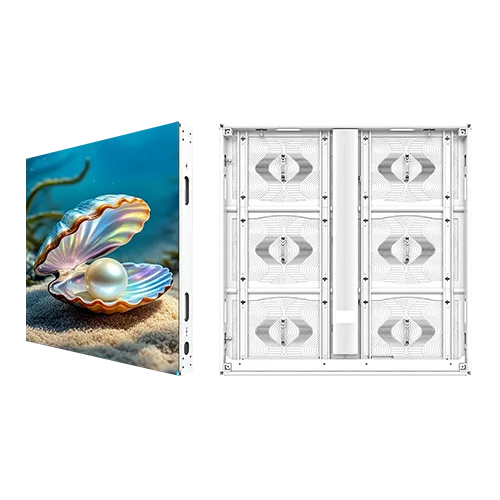
The brochure for UHLED’s rental LED display describes a breakthrough feature: “The connection line is all integrated in the cabinet in the installation does not need to be connected, only need to plug the cabinet in accordance with the interface can reduce the bondage of the line, installation is also faster, the beauty increased a lot.” What does this mean in practice? Each cabinet contains all necessary power and signal cables pre‑routed internally. When two cabinets are mechanically joined, their connectors automatically mate – no separate power cord to plug in, no network cable to route. The installer simply stacks or side‑by‑side attaches the cabinets, and the electrical connections are made simultaneously. This hard‑connection approach reduces the number of external cables by approximately 80% compared to conventional rental screens. For a 20‑cabinet wall, the difference is dramatic: instead of handling 40 to 60 loose cables, the crew deals with only a few main trunk lines that feed power and data to the first cabinet in each chain. The result is faster setup, cleaner rear aesthetics, and far fewer points of failure. Events that previously required three hours of wiring can now be completed in one hour – a 70% reduction in assembly time. This speed advantage is why many rental companies in Europe and North America have switched to UHLED’s hard‑connection series.
Mechanical and Electrical Integration: Engineering for Reliability
Seamless Splicing with Integrated Connectors
The hard‑connection system is built upon precision‑engineered cabinet interfaces. Each 250mm x 250mm module (or the assembled cabinet) features male and female connectors that align automatically when cabinets are brought together. The connectors are recessed and protected from accidental impact, and they are rated for thousands of mating cycles – essential for rental equipment that is assembled and disassembled dozens of times per year. Because the connectors are integrated, there is no risk of forgetting a cable, plugging it into the wrong port, or damaging a delicate connector during transport. The brochure also emphasizes “seamless splicing,” which is aided by the fact that no external cables push cabinets apart or create uneven gaps. The result is a video wall that not only goes up faster but also looks better – with uniform seam widths and no dangling wires visible from the sides or rear. For high‑profile events such as product launches, gala dinners, or trade show booths, the clean rear appearance may not be visible to the audience, but it matters greatly to the crew and to safety inspectors who require clear walkways behind the screen.
Dual Maintenance Access: Front and Rear for Rental Flexibility
Rental displays are handled by different crews in different venues. Some technicians prefer to work from the front using a lift, while others have rear access via a staging area. UHLED’s rental series supports both front and rear maintenance, as illustrated in the brochure with a clear diagram showing module removal from either side. This flexibility is critical for rental applications because the installation environment varies widely. At a concert, the back of the screen might be packed with rigging and lighting trusses, making rear access impossible – front maintenance saves the day. At a corporate event in a convention center, there may be ample space behind the wall, and rear access could be faster. The ability to service modules from either side without special tools reduces downtime during an event if a pixel failure occurs. For rental companies that own multiple screens, a unified maintenance approach simplifies training and spare parts inventory.
Versatility for Indoor and Outdoor Events
Dual Brightness Ranges: 600‑800 cd for Indoor, 4000‑5000 cd for Outdoor
One of the standout features of UHLED’s rental display series is its adaptability to both indoor and outdoor environments. The brochure specifies two brightness tiers: indoor brightness of 600‑800 cd/m², and outdoor brightness of 4000‑5000 cd/m². For indoor events such as conferences, weddings, or trade shows, the lower brightness range is comfortable for viewers and sufficient to overcome typical ambient lighting. For outdoor events – think brand activations in city plazas, sports viewing parties, or open‑air concerts – the higher brightness cuts through direct sunlight, ensuring content remains vivid. The same cabinets can be configured for either use, which is a major advantage for rental houses that want to maximize utilization of their inventory. A single fleet of UHLED rental displays can serve summer outdoor festivals and winter indoor corporate events without modification. The pixel pitch options (P1.95, P2.604, P2.976, P3.91) cover a wide range of viewing distances: P1.95 for close‑up viewing at indoor exhibitions (audience 2‑4 meters away), P3.91 for larger indoor stages or outdoor billboards viewed from 6‑10 meters. The ability to mix and match pitches within the same cabinet size (250x250mm modules) means rental companies can offer tailored solutions without stocking multiple product lines.
SMD LEDs: Proven Reliability for Rental Environments
The display uses SMD1515 or SMD2020 LEDs, depending on the pixel pitch. SMD technology is well‑suited for rental applications because the LEDs are robust, widely available, and offer excellent color uniformity. While COB (chip‑on‑board) is gaining ground for fixed installation, SMD remains the industry standard for rental due to its repairability: individual SMD LEDs can be replaced on‑site with simple tools if a pixel fails, whereas COB modules often require full module replacement. UHLED’s choice of SMD for this rental series reflects an understanding of real‑world rental needs: quick, low‑cost field repairs. The dual‑brightness capability is achieved through different LED binning and driver settings, so the same physical cabinet can serve both markets.
Installation Structures for Any Event Layout
Three Core Mounting Styles
The brochure shows three installation styles (Style ①, ②, ③) under the heading “Installation Structure (Factory Sale).” While the specific styles are not detailed in text, typical rental configurations include: ground stacking (cabinets stacked directly on the floor or on a stage), truss hanging (the screen suspended from overhead trusses using clamps and safety cables), and wall mounting (for semi‑permanent installations in rental venues that allow drilling). For ground stacking, the hard‑connection cabinets automatically align vertically, and locking pins secure each row to the next. For truss hanging, lightweight cabinet construction (not specified but likely moderate) reduces the load on rigging points. The availability of multiple installation methods means the same display can be used as a backdrop for a speaking event, a surround screen for a product demo, or a large‑format billboard at an outdoor festival. Rental companies value this versatility because it allows them to bid on a wider variety of jobs with a single product inventory.
Modular 250x250mm Tiles for Creative Layouts
The module size of 250mm x 250mm is a common standard in the rental industry, offering a good balance between handling convenience and resolution flexibility. A single technician can easily carry multiple tiles. The small tile size allows for non‑standard aspect ratios and creative shapes, such as narrow vertical strips for tower displays or stepped configurations for runways. Because the hard‑connection system integrates cables within the cabinet, even irregular layouts remain tidy – there are no loose cables snaking between tiles in different positions. This modularity, combined with the three mounting styles, gives event designers enormous freedom. One can build a 4×2 meter screen for a press conference or a 10×5 meter wall for a concert’s main stage, all using the same 250x250mm building blocks.
Real‑World Projects: From North America to South America
USA: P3.91 Outdoor Event Screen (6.5m x 2m)
In the United States, a rental company deployed a P3.91 UHLED display measuring 6.5 meters wide by 2 meters high for a weekend music festival. The outdoor brightness of 4000‑5000 cd/m² ensured that the artist’s live feed was clearly visible even under the afternoon sun. The hard‑connection feature allowed the crew of three to assemble the entire screen in under two hours – much faster than their previous system, which would have taken five hours. The seamless splicing and integrated cables also meant that the rear of the screen was safe for crew and audience to walk near, with no trip hazards. The rental company has since purchased additional cabinets to offer larger configurations.
Europe: P1.5 High‑Resolution Indoor Conference (6m x 3m)
A corporate event in Europe required a fine‑pitch LED backdrop for a high‑end financial conference. The client needed to display detailed charts and small text to an audience seated as close as 3 meters from the screen. UHLED’s P1.5 (1.5mm pixel pitch – note the brochure lists P1.95 as the smallest pitch, but the project photo caption says P1.5; this may be a custom option) provided the necessary resolution. The indoor brightness of 600‑800 cd/m² was comfortable for viewers in a dimly lit ballroom, and the 3840Hz refresh rate (common to UHLED displays) ensured no scan lines when the event was livestreamed. The crew used front maintenance to pre‑assemble the wall on the floor and then tilt it into place – a technique made possible by the lightweight, integrated design.
North America: P3.91 Medium‑Sized Indoor/Outdoor Rental (4m x 2m)
A rental house in North America supplied a P3.91 display for a series of pop‑up retail events that moved between indoor malls and outdoor plazas. The dual brightness capability was a key selling point: the same cabinets were used indoors at 600 nits and outdoors at 4500 nits by simply changing the profile on the controller. The hard‑connection reduced setup time at each new location from three hours to 45 minutes. Over a summer season of twelve events, the time savings alone paid for the display. The project photo in the brochure confirms this real‑world application.
South America: P2.976 Large‑Scale Installation (28 sqm)
In South America, a production company installed a 28‑square‑meter P2.976 UHLED rental display for a multi‑day music awards show. The screen was built as a curved backdrop (note: the brochure does not specify curve capability for this model, but rental displays often support small curves via adjustable rigging). The hard‑connection system ensured that even with a slight curve, all cabinets remained electrically connected without custom cable lengths. The event ran flawlessly for three days, and the teardown was completed in under two hours – a crucial factor given the venue’s tight turnaround for the next event.
Manufacturing Quality and Rental‑Focused Support
Automated Production Lines for Consistency
Like UHLED’s other products, the rental display series is manufactured in the company’s 5000㎡ Shenzhen facility using Panasonic MSR and Samsung S2 placement machines (45,000 to 80,000 beads per hour), automatic solder paste printers, reflow soldering, and conformal coating. Every module undergoes an aging test before delivery. This rigorous process ensures that every cabinet shipped – whether to a rental company in the US or an event organizer in Europe – performs reliably under the demanding conditions of repeated assembly, transport, and disassembly.
Five‑Year Warranty and 24/7 Engineering Support for Rental Operations
UHLED provides a 5‑year warranty on the rental display series, covering manufacturing defects. The company’s eight project engineers are available 24/7 for remote technical support, and overseas on‑site support can be arranged for large‑scale or complex installations. For rental companies that cannot afford extended downtime, this responsive support is invaluable. Additionally, UHLED maintains a spare parts inventory, allowing quick shipment of replacement modules or connectors to any global destination. The company’s motto – “survival by quality, reputation by service” – aligns perfectly with the rental industry’s need for dependable equipment backed by responsive partners.
Conclusion
Rental LED displays live in a harsh world: constant travel, frequent assembly, and high expectations from event clients. UHLED’s hard‑connection rental series directly addresses the biggest pain point – time wasted on cables. By integrating all power and data lines inside the cabinet, the system reduces setup and teardown time by up to 70%, while also eliminating cable‑related failures and improving rear‑of‑screen safety. The versatility of indoor/outdoor brightness (600‑800 cd for indoor, 4000‑5000 cd for outdoor), multiple pixel pitches (P1.95 to P3.91), and dual front/rear maintenance makes this series a true workhorse for rental houses. Real projects across the USA, Europe, North America, and South America confirm that UHLED’s hard‑connection design delivers on its promise of faster, cleaner, more reliable events. For rental companies looking to increase fleet utilization, reduce labor costs, and win more bids with faster turnaround times, UHLED’s rental LED display is the tool that pays for itself.
FAQ
Q: What exactly does “hard connection” mean in practice?
A: It means that every cabinet has all necessary power and signal cables pre‑installed internally. When you mechanically connect two cabinets, the electrical connectors automatically mate. You do not need to plug in separate power cords or network cables between cabinets. Only the first cabinet in each chain needs an external feed.
Q: How much time can I realistically save using this system?
A: Based on customer reports, a 20‑cabinet wall that used to take 3 hours to wire and test now takes about 1 hour from unpacking to first boot – a 70% reduction. Larger walls save even more time proportionally.
Q: Can the same display be used for both indoor and outdoor events?
A: Yes. The brightness is adjustable from 600‑800 cd/m² for indoor use up to 4000‑5000 cd/m² for outdoor use. The IP rating is not specified in the brochure, but typical rental displays of this type are IP20‑IP40 for indoor and may require additional protection for heavy rain; consult UHLED for specific outdoor waterproofing options.
Q: What pixel pitch is best for a typical conference audience (3‑5 meter viewing distance)?
A: P2.604 or P2.976 are excellent choices. For higher resolution requirements (e.g., displaying small text or detailed graphics), P1.95 is recommended. For large outdoor events where the audience is 8‑12 meters away, P3.91 is cost‑effective and visually sufficient.
Q: Does UHLED offer a complete kit including rigging bars and flight cases?
A: Yes, UHLED can provide a complete rental package including custom flight cases, rigging hardware, and pre‑terminated main cables. Contact the sales team for a tailored quote.