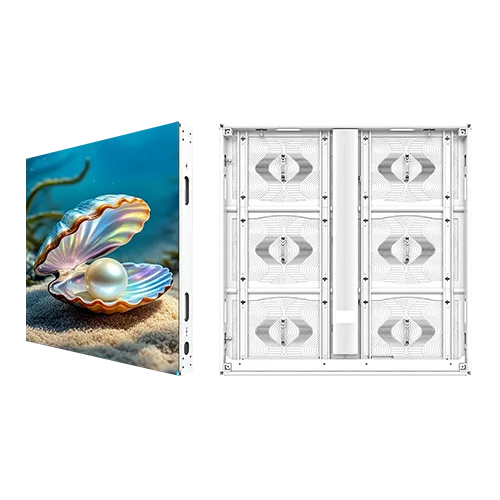
Outdoor COB LED Display
Full Flip Chip COB LED Display — P1.56 & P1.95 — IP65 Waterproof


Fixed LED displays are designed for permanent installation, with cabinet structures and mounting methods adapted to walls or dedicated supporting structures.
Rental LED displays are designed for frequent assembly, transportation, and relocation, so they typically prioritize lighter cabinets and quick locking mechanisms.
Fixed LED displays can use cabinet structures optimized for long term operation, including passive or optimized cooling depending on the product design.
Rental LED displays need to accommodate temporary deployment and transportation, so their thermal design must balance portability with operating performance.
Fixed LED displays are typically selected when the screen remains in one location for long term commercial use. Rental displays are better suited to temporary events, exhibitions, conferences, and other applications where screens need to be moved or reconfigured.
| Factor | Fixed LED Display | Rental LED Display |
| Installation | Permanent | Temporary |
| Cabinet Design | Stable structure | Lightweight structure |
| Assembly | Long term installation | Frequent assembly |
| Mobility | Low | High |
| Typical Use | Commercial spaces | Events and exhibitions |
For permanent indoor installations, the indoor LED display range can help buyers compare suitable display configurations based on project requirements.

SMD and COB are the two common LED packaging technologies used for indoor fixed LED displays. SMD technology integrates red, green, and blue chips into individual packages mounted on the circuit board and is widely used across different indoor applications.
COB technology mounts LED chips directly onto the substrate with a protective surface layer. An indoor COB LED display is suitable for fine pixel pitch applications where close viewing and surface protection are important. Buyers should compare packaging technology based on viewing distance, pixel pitch, content requirements, and installation environment.

Pixel pitch directly affects screen resolution and viewing distance. Smaller pixel pitches provide higher pixel density and are generally suitable for close viewing environments, while larger pitches can be more practical for larger spaces where viewers are farther from the screen.
For indoor fixed LED displays, P0.93 to P1.25 can suit close viewing applications such as control rooms, P1.56 to P1.87 can work well in conference rooms and corporate spaces, while P2.0 to P2.5 can be considered for larger retail venues and auditoriums. Buyers should also evaluate refresh rate and brightness according to camera requirements, ambient lighting, and viewing conditions.
Indoor fixed LED displays are commonly used in commercial environments where screens remain in a permanent location and need consistent visual performance. The required configuration depends on viewing distance, content type, screen size, and operating conditions.
Control rooms use large LED video walls for surveillance, data monitoring, mapping, and visualization. Fine pixel pitch displays can provide detailed images for operators viewing the screen from relatively close distances. Front service access can also be valuable where rear maintenance space is limited.
Conference rooms use indoor fixed LED displays for presentations, video conferencing, and corporate communications, where image detail and viewing comfort are important. Retail spaces can use fixed LED screens for promotional content, brand messaging, and digital signage, with screen size and cabinet configuration adapted to the available space.
Power efficiency is an important consideration for large scale LED video walls operating for extended periods. Common cathode LED technology can improve power utilization by controlling the power requirements of red, green, and blue LED channels more efficiently.
Actual energy consumption depends on pixel pitch, brightness settings, display content, cabinet design, and operating conditions. Buyers should therefore compare rated power specifications with expected operating conditions.
Service access affects the physical space required for installation and future maintenance. Front service designs allow technicians to access LED modules from the display side and can reduce or eliminate the need for dedicated rear service space, depending on the cabinet and installation design.
Rear service configurations require additional access space behind the display. For indoor commercial projects with limited room depth, the available maintenance space should be considered during the initial system design.
When evaluating an indoor fixed LED display manufacturer, buyers should review production capacity, quality certifications, engineering support, warranty terms, spare parts availability, and experience with similar commercial projects. Working with an established LED display manufacturer can provide access to engineering support for structural frame design, power distribution planning, and signal routing layouts.
UHLED was founded in 2015 and operates a manufacturing facility of approximately 5,000 square meters. The company reports an annual production capacity of about 120,000 square meters and maintains international certifications including CE, ETL, FCC, and RoHS.
UHLED also provides project engineering and overseas technical support. For buyers comparing potential suppliers, these factors can provide a basis for evaluating manufacturing capacity, technical resources, and experience with commercial LED display projects.
An indoor fixed LED display is a permanent visual display system mounted onto wall structures or dedicated indoor frames. Unlike temporary rental panels, fixed screens are designed for long term commercial installation and can be configured according to screen size, pixel pitch, cabinet structure, and maintenance requirements.
A commonly used rule of thumb is to relate minimum viewing distance to pixel pitch, but this should only be treated as a starting point. Screen size, content type, viewing angle, camera use, and individual visual requirements should also be considered when selecting the appropriate pixel pitch.
SMD technology houses RGB chips within individual surface mounted packages soldered to the board and is widely used across indoor LED display applications. COB technology places LED chips directly onto the substrate with a protective surface layer, making it suitable for fine pixel pitch applications where close viewing and surface protection are important.
Front service access can be advantageous for indoor installations because it allows individual modules to be serviced from the front. This design can reduce or eliminate the need for rear maintenance space, depending on the installation design, conserving valuable interior floor space.
The overall cost is influenced by pixel pitch density, packaging type such as SMD versus COB, power supply efficiency, cabinet materials, control system components, screen dimensions, and installation requirements. Finer pixel pitches generally require more LED components per square meter, which can increase production costs.
For accurate pricing based on specific project dimensions, viewing distance, and visual requirements, buyers can contact the UHLED engineering team for a suitable display configuration.
Selecting the right indoor fixed LED display involves aligning technical parameters with physical space requirements and long term operational goals. Prioritizing the appropriate pixel pitch, efficient circuit design, suitable cabinet structure, and practical service access can help balance visual performance with lifecycle costs.
Working with an experienced manufacturer can also simplify structural planning, installation coordination, maintenance, and long term technical support. Contact the UHLED technical engineering team to discuss your project requirements and obtain a suitable display configuration and quotation.