When planning a high-impact visual installation for a retail store, conference room, control center, or outdoor billboard, one critical decision shapes your entire budget and project outcome. You must choose between a Direct View LED video wall and a tiled LCD display.
Many buyers confuse these technologies because consumer television and monitor brands market their products as “LED screens.” In reality, those consumer displays are actually LCD screens that merely use a basic LED strip for backlighting.
This guide cuts through the marketing jargon from a commercial engineering perspective. We break down the structural, functional, and financial differences between true self-emissive commercial LED video walls and multi-screen LCD setups to help you make an informed procurement decision.
What is a Direct View LED Video Wall (DVLED)
A Direct View LED video wall (DVLED) is an entirely modular, self-emissive commercial display system. It does not use a liquid crystal layer or an underlying separate backlight unit to output imagery.
Instead, the screen surface itself is composed of millions of microscopic Red, Green, and Blue (RGB) light-emitting diodes mounted directly onto circuit boards via high-precision surface mount technology (SMT).
The architecture follows a strict modular hierarchy:
- The LED Module: A rectangular board packed with diodes and driver ICs (Integrated Circuits) that regulate electrical currents.
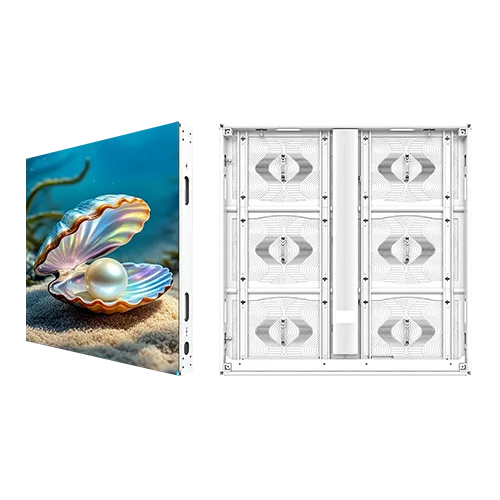
- The LED Cabinet: A rugged engineering frame (often made of die-cast aluminum or iron) that houses multiple modules and power supplies.
- The Video Wall: Dozens of these cabinets are physically interlocked together on-site. Because there are no outer bezels on the individual modules or cabinets, they form a 100% seamless digital canvas of any custom width, height, or curve.
What is a Tiled LCD Setup?
A tiled LCD setup (often referred to as an LCD video wall) consists of an array of distinct commercial flat-panel liquid crystal displays mounted tightly together on a matrix grid (such as a 2×2, 3×3, or 4×4 configuration).
Unlike self-emissive LED technology, LCD panels cannot generate their own light. Instead, they rely on a permanent internal backlight unit (usually made of LED strips running along the edges or packed behind the screen) that shines continuous white light through several hardware layers:
- The Polarization Filters: Layers that control light direction.
- The Liquid Crystal Layer: Active crystals that twist and untwist when electrical voltages are applied, acting like millions of tiny shutters to block or allow light to pass through.
- The Color Filters: Red, Green, and Blue sub-pixels that colorize the passing backlight to form the final matrix image.
Because liquid crystals are fluid, every single LCD panel requires a physical outer frame (bezel) to seal the internal matrix components. Stacking multiple LCDs together inevitably creates a grid of visible seams across the collective display.
Difference between LED Display and LCD Display
Understanding the engineering differences between self-emissive diodes and shutter-based liquid crystals explains why these two display technologies perform drastically differently in demanding commercial environments.
| Feature / Specification |
Commercial Direct View LED (dvLED) |
Tiled Commercial LCD Video Wall |
| Bezel & Gaps |
0.0mm (100% Truly Seamless). Modular tiles align perfectly to form a single continuous image without visible grid lines. |
0.8mm to 3.5mm visible grid lines. Created by the combined physical borders of adjacent active matrix LCD panels. |
| Brightness Range |
1,200 – 10,000+ nits. Standard indoor models typically range from 600 to 1,500 nits, while ultra-high brightness outdoor configurations reach up to 10,000+ nits. |
450 – 700 nits max. (Certain specialized storefront models can push to 800–1,000 nits, but standard commercial video walls top out around 700 nits). |
| Contrast Ratio |
5,000:1 to 10,000+:1. True, absolute blacks are achieved because individual diodes turn completely off when displaying black. |
1,000:1 to 4,000:1. Limited by light leakage from the active LED backlight passing through the liquid crystal layer. |
| Lifespan (To 50% Brightness) |
~100,000 Hours (Over 11 years running 24/7 continuous operation before light degradation begins). |
~50,000 Hours (Typically 50,000 to 60,000 hours due to the standard physical aging of the backlight units). |
| Refresh Rate |
≥3,840Hz – 7,680Hz. High-frequency pulse-width modulation makes the screen camera broadcast-ready with no scan lines. |
60Hz – 120Hz. Standard panel refresh rates; prone to camera flickering or rolling horizontal bands when filmed. |
| Maintenance Profile |
Modular front/rear swap (Low cost). Individual magnetic tiles, pixel cards, or single diodes can be hot-swapped without replacing the screen. |
Full panel extraction (High cost). Requires removing and replacing the entire 55″ or 65″ display module if internal components fail. |
| Shape Flexibility |
Flat, curved, cubes, cylinders, columns. Modular cabinets can be custom-configured into any custom aspect ratio (e.g., 21:9) or 3D shape. |
Strict flat rectangular grids only. Limited strictly to standard 16:9 fixed-sized matrix tiling configurations (e.g., 2×2, 3×3, 4×4). |
| Power Consumption Profile |
Dynamic. Energy consumption directly scales with on-screen content (dark scenes or black pixels draw minimal power). |
Constant. Backlights remain consistently powered at the set brightness level regardless of how dark the on-screen content is. |
| Ingress Protection (IP Rating) |
Highly adaptable. Optional surface treatments (COB/Glue-on-Board) offer robust dust and moisture resistance up to IP66. |
Typically restricted to indoor deployments. The exposed glass surfaces and chassis have no native high-level water encapsulation. |
1. Seamless Canvas vs. Broken Visuals
The primary architectural advantage of a commercial LED display is the complete elimination of bezels. Even the thinnest “extreme-narrow bezel” LCD panels leave a grid of black lines cutting through the final picture. These lines sever corporate logos, interrupt scrolling spreadsheets, and slice through human faces during presentations. DVLED cabinets align perfectly rim-to-rim, providing a completely unified visual presentation.
2. High-Nit Luminance vs. Glare and Washout
Commercial environments like airport terminals, glass atriums, and outdoor plazas are flooded with ambient light. Standard commercial LCD video walls produce 450 to 700 nits of brightness; under heavy overhead venue light or direct sunlight, LCD images suffer from high glare and wash out. True commercial LED displays emit pure, direct light forward, easily scaling from 1,200 nits for indoor fine-pitch use to over 8,000 nits for outdoor advertising, maintaining perfect contrast in any lighting condition.
3. Targeted Module Swaps vs. Whole-Panel Replacement (Long-Term Maintenance)
Hardware wear-and-tear is inevitable over years of continuous operation, but maintenance protocols differ wildly between the two systems:
- The LCD Problem: If a single backlight zone burns out or a color shift occurs on one LCD panel within a large grid, you cannot repair that specific cluster. Technicians must dismount and replace the entire heavy flat panel, which often introduces noticeable color-matching discrepancies against the surrounding older screens.
- The LED Solution: DVLED setups prioritize modular component accessibility. If a few pixel diodes drop out, a technician uses a magnetic front-maintenance tool to pop out the affected palm-sized module in under 30 seconds. The rest of the video wall stays active, and a spare module from the original manufacturing batch can be swapped in to maintain immaculate factory color calibration.
Matching the Right Technology to Your Application
While Direct View LED delivers superior performance, lifespan, and brightness, your final engineering choice depends entirely on your viewing distances, structural environments, and project goals.
When to Source High-Density LCD Panels:
LCD technology remains a practical option for static, close-up viewing applications where observers stand or sit less than 1.5 meters away from the screen and the total display footprint does not exceed a standard 165-inch diagonal layout. Typical use cases include:
- Budget-conscious secondary school classrooms.
- Basic, non-tiled static digital menu boards behind fast-food counters.
- Small indoor desktop security monitoring stations where seamlessness is not a priority.
When to Source Commercial LED Video Walls:
True LED display screen solutions are mandatory whenever your project demands high-impact premium branding, non-standard shapes, or absolute environmental durability:
- Stage Events & Touring Public Venues: Rental LED displays utilize specialized hard or flexible connections to build massive, fast-assembly backdrops. They offer ultra-high refresh rates (≥3,840Hz) to eliminate scanning lines when captured by broadcast cameras.
- Corporate Boardrooms & Mission-Critical Control Rooms: High-density Fine Pitch screens and advanced Chip-on-Board (COB) or Micro LED in Package (MIP) encapsulation provide deep blacks and razor-sharp text legibility for 24/7 command centers.
- Retail Spaces & Premium Outdoor Media: Weatherproof outdoor aluminum or iron cabinet displays are rated IP65+ to seal out heavy rain and dust. They deliver the raw luminance needed to cut through direct noon sunlight, maximizing commercial advertising ROI.
Conclusion
While a tiled LCD setup often requires a lower initial hardware investment, it comes with a shorter lifespan, higher power consumption per square meter, and steep full-panel replacement risks. For enterprises, retail brands, and system integrators looking for a long-term display asset, modular commercial LED walls offer significantly lower total cost of ownership (TCO), superior visual performance, and absolute design freedom.
At UHLED, we engineer custom commercial LED display solutions tailored to your precise structural and technical specifications. From automated high-speed SMT production to rigorous module aging tests, our engineering team manages the full chain of production to ensure your display project operates flawlessly for years to years. Request an engineering consultation and custom solution quotation.
Frequently Asked Questions
Why do some people say LED displays are too pixelated for close-up viewing?
This is an outdated misconception from the era of large-scale outdoor billboards. Modern manufacturing allows for ultra-fine pixel pitches (such as P0.9 to P1.56). By placing pixels closer together, fine-pitch indoor LED walls provide crisp, high-definition text and graphics even when viewed from just a few feet away, making them excellent replacements for boardroom projectors and LCDs.
Is it hard to color-calibrate an LED video wall compared to LCDs?
Actually, it is much easier. Commercial LED displays use advanced calibration software embedded directly into the receiving cards and driver ICs. If you ever replace an LED module, technicians can adjust pixel-level brightness and color coordinates instantly to match the rest of the display perfectly. Tiled LCD panels naturally shift colors independently as their backlights age, making uniform calibration across panels notoriously difficult over time.
Can a commercial LED display handle curved architecture?
Yes. Unlike rigid LCD glass panels that cannot bend, LED display modules can be manufactured on flexible PCBs. This allows creative designers to install smooth concave or convex curves, wrap columns, or create 90-degree corner displays for immersive retail stores and creative exhibitions.