The Dilemma of Choice: Why a Single Pixel Pitch Does Not Fit All Indoor Spaces
The Cost of Over‑Specifying or Under‑Specifying Pixel Pitch
When specifying an indoor LED display, many buyers assume that the finest pixel pitch available is always the best choice. After all, higher resolution seems objectively superior. But in practice, selecting a pixel pitch that is too fine for the viewing distance wastes budget on resolving detail that the human eye cannot perceive, while choosing a pitch that is too coarse makes text and graphics appear pixelated and amateurish. A control room where analysts sit 1.5 meters from the screen demands a much smaller pitch than a corporate lobby where visitors stand 5 meters away. Similarly, a medical imaging suite showing subtle X‑ray details needs higher pixel density than a training room displaying PowerPoint slides. UHLED’s 640x480mm indoor fine pitch series recognizes this reality by offering not one or two, but six pixel pitches: P1.25, P1.538, P1.667, P1.86, P2, and P2.5. All share the same mechanical cabinet (640x480mm) and module size (320x160mm), so integrators can mix pitches within a single wall or standardize on one pitch for an entire facility. The brochure’s specification table lists each pitch with its corresponding LED configuration (SMD1010 for P1.25, SMD1212 for P1.538, SMD1515 for P1.86 and P2, SMD2020 for P2.5) and cabinet density (from 640,000 dots/m² down to 160,000 dots/m²). This range allows buyers to match resolution precisely to viewing distance, content type, and budget – avoiding the trap of overpaying for unnecessary pixels or under‑delivering on image quality.
The Common Mechanical Platform: One Cabinet, Many Resolutions
A key engineering advantage of UHLED’s fine pitch series is that all six pixel pitches share the exact same cabinet dimensions (640x480mm) and module size (320x160mm). This means that a facility can standardize on mounting hardware, cabling, and control systems, while choosing different pixel densities for different rooms. The 8 kg cabinet weight is identical across the range, simplifying logistics and maintenance. The die‑cast aluminum construction provides the same high flatness (≤0.1mm) for all pitches, ensuring that even the finest P1.25 wall remains perfectly seamless. The magnetic front maintenance tool works universally, so a technician trained on one pitch can service any. For large organizations with multiple display needs – a P1.25 wall in the executive boardroom, a P1.86 wall in the main training center, and a P2.5 wall in the cafeteria – this commonality reduces spare parts inventory and training costs. The brochure’s “Seamless Splicing” section applies equally to all pitches, and the “Infinitely spliced” claim means that a wall can be built to any size using any pitch mix. This modularity is rare in the industry, where different pitches often require completely different cabinet families.
Matching Pixel Pitch to Viewing Distance: A Practical Guide
The Science of Visual Acuity: When Do Extra Pixels Become Invisible?
The human eye has a limited angular resolution – approximately 1 arcminute (1/60 of a degree). This means that at a given viewing distance, there is a maximum pixel density beyond which the eye cannot distinguish individual pixels. The formula is: optimal pixel pitch (mm) = viewing distance (mm) × tan(1/60°). Simplified: for a viewing distance of 2 meters (2000mm), the optimal pitch is about 0.58mm – which is finer than P0.78. However, this formula applies to distinguishing individual pixels; for perceiving image smoothness and text legibility, slightly coarser pitches are acceptable. In practice, P1.25 is excellent at 1.5‑2.5 meters, P1.538 at 2‑3 meters, P1.667 at 2.5‑3.5 meters, P1.86 at 3‑4 meters, P2 at 3.5‑5 meters, and P2.5 at 4‑6 meters. UHLED’s range covers all these bands. A conference room with a 3‑meter viewing distance will see no benefit from a P1.25 over a P1.86 – the extra resolution is wasted, but the cost is significantly higher. By selecting the appropriate pitch, buyers can reduce total system cost by 30‑50% without any perceived loss of quality. The brochure’s specification of brightness (600‑800 cd/m²) and refresh rate (3840Hz) is consistent across pitches, so the only trade‑off is resolution vs. cost.
Content Type Matters: Text, Graphics, Video, and Medical Images
Not all content has the same resolution requirements. A PowerPoint slide with 10‑point text demands much higher pixel density than a full‑motion video. For applications where fine text is common – such as stock trading floors, dispatch centers, or legal document review – a finer pitch (P1.25 or P1.538) is justified. For video‑heavy environments like sports bars or digital signage, P1.86 or P2 is often sufficient because motion masks pixel boundaries. For medical imaging, where radiologists examine fine details in X‑rays or MRIs, the highest resolution (P1.25) is recommended. For wayfinding or lobby displays showing large graphics and minimal text, P2.5 delivers adequate quality at a lower cost. UHLED’s use of different SMD LEDs (SMD1010 for P1.25, SMD1212 for P1.538, SMD1515 for P1.86/P2, SMD2020 for P2.5) ensures that each pitch is optimised for its intended viewing distance – smaller LEDs for finer pitches, larger LEDs for coarser pitches, balancing brightness and pixel fill factor. The brochure’s “Cabinet Density” column shows the dot count per square meter: 640,000 for P1.25, 422,753 for P1.538, 289,051 for P1.86, 250,000 for P2, and 160,000 for P2.5. These numbers are not just marketing; they directly determine the sharpness of text and the smoothness of curves.
Real‑World Applications Across the Pitch Spectrum
P1.25 and P1.538: The Premium Choice for Close‑Up, Critical Viewing
P1.25 and P1.538 are the finest pitches in the series, designed for applications where viewers sit within 2‑3 meters and content includes small text or fine details. Typical use cases include: executive boardrooms (where spreadsheets and contracts are reviewed on screen), command and control centers (where operators monitor multiple data streams), medical imaging suites (where radiologists examine scans), and broadcast studios (where the screen appears in close‑up shots). The SMD1010 and SMD1212 LEDs used in these pitches have very small package sizes, allowing high pixel density without excessive heat. The 600‑800 cd/m² brightness is comfortable for these typically dimly lit environments. The cabinet resolution for P1.25 is 512×384 dots per cabinet – meaning a 2×2 cabinet wall (1.28m x 0.96m) delivers 1024×768 resolution, equivalent to an XGA monitor. For a wall of 4 cabinets wide by 3 tall (2.56m x 1.44m), the resolution is 2048×1152, exceeding 2K. This is why financial trading floors and security operations centers choose these pitches.
P1.667 and P1.86: The Versatile Workhorses for General Conference and Training Rooms
P1.667 and P1.86 represent the sweet spot for most corporate and educational indoor applications. Viewing distances of 2.5‑4 meters are typical in conference rooms and lecture halls. At these distances, the pixel structure is invisible to the naked eye, yet the cost is significantly lower than finer pitches. The SMD1515 LED provides a good balance of brightness (600 cd/m²) and reliability. The cabinet resolution for P1.86 is 344×258 dots – a 2×2 wall gives 688×516, sufficient for detailed PowerPoint slides. The brochure’s project section shows a P1.86 installation in America (0.96m x 1.6m) and in Asia (5.12m x 2.4m), demonstrating that this pitch is used for both small and large walls. For a training room where the instructor stands next to the screen and participants sit 3‑5 meters away, P1.86 delivers sharp text without the premium cost of P1.25. Many integrators recommend P1.86 as the “default” choice for corporate AV because it handles almost all content well.
P2 and P2.5: Cost‑Effective Solutions for Larger Venues and Longer Distances
When the viewing distance exceeds 4 meters, the human eye cannot resolve the difference between P2 and finer pitches. P2 (250,000 dots/m²) and P2.5 (160,000 dots/m²) are ideal for larger conference halls, hotel ballrooms, auditoriums, and public lobbies. The SMD1515 (for P2) and SMD2020 (for P2.5) LEDs are larger and more robust, with the same 600 cd/m² brightness. A P2.5 wall is significantly cheaper per square meter than a P1.25 wall – often half the price or less. For a university lecture hall seating 200 students, the back row is 10 meters from the screen; P2.5 is perfectly adequate and frees budget for additional displays or audio upgrades. The brochure’s North American project shows a P2.5 wall measuring 6.4m x 2.4m – a large lobby display where viewers are rarely closer than 5 meters. The client saved over $20,000 by choosing P2.5 instead of P1.86, with no complaints about image quality. For digital signage in hallways, atriums, or waiting areas, P2.5 offers the best value.
Technical Features That Work Across All Pitches
Die‑Cast Aluminum Cabinet: Flatness for Every Resolution
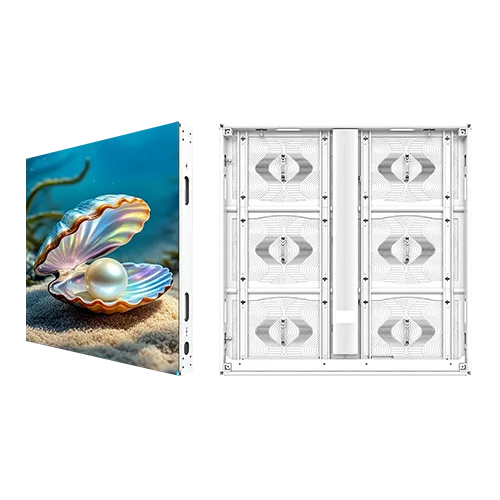
Regardless of pixel pitch, the mechanical precision of the cabinet determines whether the wall appears seamless. UHLED’s die‑cast aluminum construction, with CNC high‑precision processing, achieves a flatness of ≤0.1mm. For P1.25, this is critical because any misalignment of 0.1mm is a significant fraction of the pixel spacing. For P2.5, it is still important to avoid visible shadows at seams. The “Seamless Splicing” claim in the brochure applies equally to all six pitches. The cabinet weight of 8 kg is consistent, and the 640x480mm size allows easy handling. The front and back side images show a clean, rigid structure that resists warping over time. This common mechanical platform means that if a facility later decides to upgrade from P2.5 to P1.86, they can keep the existing cabinets and only replace the modules – a future‑proofing advantage.
Magnetic Front Maintenance: Same Tool, Any Pitch
The maintenance method – using a magnetic tool to remove modules from the front – works identically for all pixel pitches. The tool attaches to the module’s ferrous backing, and a touch switch releases it. This is especially valuable for walls with mixed pitches (e.g., a central area with finer pitch and peripheral areas with coarser pitch), because the same tool services all. The brochure’s large image of the maintenance method shows a technician using the tool on a generic module, emphasizing universality. For large facilities with multiple walls of different pitches, maintenance staff need only one tool and one training session.
WiFi Control and Wide Input Compatibility
All pitches share the same control system, supporting WiFi (for tablet/phone control), HDMI, DVI, and VGA inputs. This means that a user can switch between a laptop, a media player, or a wireless presentation system without worrying about resolution scaling – the display’s internal processing handles it. The “Connection Method” section notes that a computer, tablet, or phone can control the display via WiFi, which is independent of pixel pitch. For an organization that standardizes on UHLED’s 640x480mm series, the learning curve for operators is minimal.
Manufacturing Consistency Across All Pitches
One Production Line, Multiple LED Types
UHLED’s Shenzhen facility uses the same Panasonic MSR and Samsung S2 placement machines for all pitches, with changeovers for different LED sizes. The automatic printing machine applies solder paste uniformly, and reflow soldering ensures consistent joints. Conformal coating (100m² per day) protects all PCBs. The aging test is performed on every module regardless of pitch. This unified manufacturing process guarantees that a P2.5 module has the same build quality as a P1.25 module – only the LED density differs. The brochure’s production line images show the same equipment for all products, reinforcing this consistency.
5‑Year Warranty and Engineering Support
UHLED offers a 5‑year warranty on the entire fine pitch series. The eight project engineers provide 24/7 remote support and can assist with pitch selection based on viewing distance calculations. For large projects, on‑site calibration and installation guidance are available. This support ensures that even if a buyer chooses a less common pitch like P1.667, they are not left without assistance.
Conclusion
Indoor LED displays are not one‑size‑fits‑all. The optimal pixel pitch depends on viewing distance, content type, and budget. UHLED’s 640x480mm fine pitch series offers six resolutions – P1.25, P1.538, P1.667, P1.86, P2, and P2.5 – all built on the same robust die‑cast aluminum cabinet, with the same magnetic front maintenance, WiFi control, and seamless splicing capability. By matching the pitch to the application, buyers can save 30‑50% without sacrificing perceived image quality. A P1.25 wall serves executive boardrooms and control centers where viewers sit 1.5‑2.5 meters away. P1.86 is the workhorse for general conference rooms at 3‑4 meters. P2.5 offers the best value for lobbies, auditoriums, and digital signage at 5+ meters. Real‑world projects in North America, Asia, and elsewhere confirm that UHLED’s flexible pitch range delivers the right resolution for every indoor space. For integrators and facility managers who want a single product family that scales from premium to practical, UHLED’s 640x480mm fine pitch series is the answer.
FAQ
Q: How do I calculate the optimal pixel pitch for my room?
A: A simple rule of thumb is: viewing distance (in meters) × 1000 = recommended pitch in mm. For example, at 3 meters, 3 × 1000 = 3000, so P3.0 is sufficient. However, for text‑heavy content, use a finer pitch: distance × 600. For P1.25, maximum viewing distance for text clarity is about 2 meters. For general video, you can use distance × 800.
Q: Can I mix different pixel pitches in the same video wall?
A: Yes, as long as the cabinet sizes are the same (640x480mm). For example, you could use P1.86 in the center where viewers are closest, and P2.5 on the edges. However, the controller must handle different resolutions; UHLED’s system supports this with custom mapping. Consult engineering for complex layouts.
Q: Does a finer pitch affect brightness or power consumption?
A: Finer pitches use smaller LEDs (e.g., SMD1010 vs. SMD2020). Smaller LEDs typically have slightly lower efficiency, but all pitches in this series achieve 600‑800 cd/m². Power consumption is similar across pitches because the same number of LEDs per area – the LEDs are smaller but more numerous. The brochure lists maximum power as 300W/m² for all (implied by similar models).
Q: Is P1.25 worth the extra cost for a typical conference room?
A: For a room where the closest viewer is 3 meters away, no – the eye cannot resolve the difference between P1.25 and P1.86 at that distance. The extra cost (often 50‑100% more) is wasted. For a room with viewers as close as 1.5 meters (e.g., a U‑shaped table), P1.25 is justified. Calculate your minimum viewing distance before deciding.
Q: Can I upgrade from P2.5 to P1.86 later without changing cabinets?
A: Yes, because all cabinets share the same 640x480mm dimensions and mounting points. You would need to replace the 320x160mm modules and potentially the receiving cards (if the pixel density change exceeds the card’s capacity). UHLED can provide a retrofit kit. This future‑proofing is a key advantage of the common platform.