The Hidden Enemy of Fine Pitch LED Walls: Mechanical Imperfection
Why Even Sub‑Millimeter Gaps Ruin the Viewing Experience
When investing in a fine pitch LED display with pixel pitches as small as P1.25, buyers expect a seamless, near‑perfect image. However, many indoor video walls suffer from a problem that has nothing to do with the LEDs themselves: uneven cabinet alignment. Traditional folded‑steel or plastic cabinets can warp slightly during manufacturing, storage, or installation. When multiple cabinets are spliced together, these tiny warps accumulate, creating visible seams, steps, or gaps between modules. On a coarse‑pitch billboard viewed from 20 meters, a 0.5mm misalignment goes unnoticed. But on a P1.25 display viewed from 2 meters, even a 0.2mm step casts a shadow and breaks the continuity of the image. The human eye is extremely sensitive to straight line disruptions – a misaligned seam becomes a constant distraction, especially when displaying fine text, tables, or engineering drawings. Worse, thermal expansion and contraction can worsen these imperfections over time, turning a once‑perfect wall into a patchwork of uneven tiles. UHLED’s 640x480mm fine pitch indoor LED series addresses this root cause by building every cabinet from die‑cast aluminum, a material chosen specifically for its dimensional stability and flatness. The result is a video wall that remains visually seamless from the day of installation to years later.
Die‑Cast Aluminum: The Foundation of Flawless Splicing
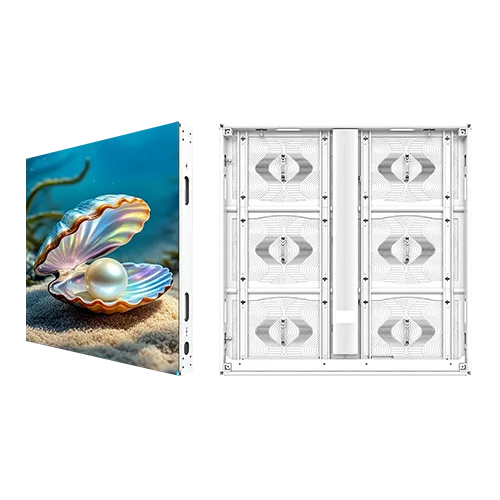
The brochure emphasizes “Die‑cast aluminum material” and “The cabinet structure has high flatness and can be spliced infinitely, so that the picture does not deform.” Die‑casting injects molten aluminum into a precision‑ground mold under high pressure, producing a cabinet that is perfectly flat, with consistent wall thickness and no internal stresses. Unlike plastic injection‑molded parts, which can warp as they cool, or steel cabinets, which may require additional machining, die‑cast aluminum emerges from the process ready for assembly. UHLED’s 640x480mm cabinets weigh 8 kg each – substantial enough to provide rigidity but not excessively heavy. This weight, combined with the material’s inherent stiffness, ensures that when two cabinets are locked together, their front surfaces lie exactly in the same plane. The brochure’s photos of “The back side” and “The front side” illustrate a clean, robust structure. For large video walls – such as the 6.4m x 2.4m P2.5 installation shown in the projects – the cumulative flatness across dozens of cabinets remains within fractions of a millimeter. This mechanical precision is what allows a fine pitch display to present a truly seamless canvas, indistinguishable from a single giant monitor.
Engineering Seamlessness: How Flatness Enables Infinite Splicing
The Role of High Flatness in Fine Pitch Applications
Flatness is not a binary attribute; it is a specification measured in millimeters or fractions thereof. For a P1.25 display, the pixel spacing is 1.25mm. If two adjacent cabinets have a vertical step of 0.3mm, that step represents nearly one quarter of a pixel height. When displaying a horizontal line across the seam, the line will appear to jump. UHLED’s die‑cast aluminum process, combined with subsequent CNC finishing if needed, achieves a flatness that the brochure simply calls “high flatness.” In practice, this means that when you run your finger across the seam, you feel no edge – the transition is perfectly smooth. This level of flatness is essential for applications such as medical imaging, where a radiologist might be evaluating a fracture line across the center of the wall, or for stock market displays where every pixel of a moving ticker must flow uninterrupted. The ability to “splice infinitely” means there is no practical limit to the wall size: you can build a 10‑meter‑wide command center wall or a 5‑meter‑tall auditorium display, and every seam will be equally invisible. The 640x480mm cabinet size scales easily because the mechanical design is modular and repeatable.
From 320x160mm Modules to 640x480mm Cabinets to Any Wall Size
The building blocks start with 320x160mm modules, which are populated with SMD1010, SMD1212, SMD1515, or SMD2020 LEDs depending on the pixel pitch. Four modules (two wide, two high) are mounted onto a die‑cast aluminum frame to form a 640x480mm cabinet. The cabinet’s edges are machined with precision alignment pins and locking mechanisms. When an installer joins multiple cabinets, these pins force the cabinets into correct relative positions, and the locks hold them there. Because the cabinets themselves are flat and rigid, the only potential for error is the locking system – and UHLED’s design minimizes play. The brochure’s “Seamless Splicing” section, with its front and back side images, implies that the cabinets can be arranged in any grid configuration. For the 6.4m x 2.4m project (10 cabinets wide by 5 cabinets high), the result is a wall that behaves optically as one unit. The high pixel density – up to 640,000 dots per square meter for P1.25 – is only fully utilized if the mechanical foundation is perfect. Die‑cast aluminum provides that foundation.
Beyond Visual Seamlessness: Structural and Thermal Benefits
No Deformation Over Time: Stability Across Seasons
One common failure mode of lower‑quality LED walls is gradual deformation. Plastic cabinets absorb moisture and expand; steel cabinets may develop rust or stress relaxation at weld points. Die‑cast aluminum is dimensionally stable across a wide temperature and humidity range. In a conference room that cycles between air‑conditioned cold in summer and heated dryness in winter, an aluminum cabinet will not swell, shrink, or twist. This stability ensures that a wall aligned during installation remains aligned years later. The 100,000‑hour LED life is matched by a cabinet life that can exceed the building’s own renovation cycle. For owners who consider a video wall a long‑term asset, the choice of aluminum over plastic or cheap steel is a decision to avoid recurring recalibration costs and service calls.
Passive Heat Dissipation for Quiet, Reliable Operation
Fine pitch displays pack many LEDs into a small area. Heat is a natural byproduct, and excessive heat accelerates LED degradation. Die‑cast aluminum acts as an excellent passive heatsink: the entire cabinet body conducts heat away from the modules and radiates it to the ambient air. UHLED’s design does not rely on fans, keeping the display silent – a requirement for boardrooms, lecture halls, and recording studios. The 8 kg cabinet mass provides enough thermal mass to smooth out temperature spikes. The specification table lists a lifespan of ≥100,000 hours, which is achievable partly due to this efficient thermal management. By contrast, plastic cabinets insulate heat, forcing manufacturers to add noisy fans or accept shorter LED life. UHLED’s aluminum solution thus contributes to both seamlessness (through stability) and long‑term reliability.
Maintenance and Control Without Compromising the Seamless Wall
Magnetic Front Maintenance: Preserving the Flush Installation
A seamless video wall is often mounted flush with the surrounding architecture – no rear access, no protruding service corridor. UHLED’s magnetic front maintenance tool (shown in the brochure) allows a technician to remove any module from the front without disturbing adjacent cabinets or the wall structure. The process is simple: apply the magnetic tool, press the switch, and pull the module out. This design means that even a large 6.4m x 2.4m wall can be serviced entirely from the front, preserving the clean, seamless appearance and saving valuable room space. For facilities managers, the ability to swap a module in under two minutes without specialized training reduces downtime and eliminates the need to keep a rear service aisle. The brochure explicitly states “Use a magnetic tool to remove the module from the cabinet for maintenance,” confirming that this is the standard method. Because the tool attaches magnetically, there is no risk of scratching the module surface or damaging the delicate SMD LEDs.
WiFi Control and Multiple Inputs: Flexible Operation from Any Device
While the visual seamlessness is the headline feature, the display also supports modern control methods. The “Connection Method” section notes that “Computer tablet computer and phone support WIFI control.” This means that a presenter can change content, adjust brightness, or turn the screen on/off directly from a mobile device without needing a dedicated control room. The input signal options include HDMI, DVI, SDI, WIFI, and USB – covering everything from a laptop to a broadcast camera. For a university lecture hall, the professor can walk in with a tablet and wirelessly display slides on the seamless fine pitch wall. For a corporate boardroom, the IT team can manage multiple walls from a central console. These capabilities enhance the user experience without adding visible cables or disrupting the clean, seamless aesthetic. The 16‑bit gray level and ≥3840Hz refresh ensure that even wirelessly streamed content appears smooth and flicker‑free.
Real‑World Proof: Large‑Scale Seamless Installations Across Continents
North America: 6.4m x 2.4m P2.5 Display for a Corporate Lobby
The brochure’s first project photo shows a North American installation with P2.5 pixel pitch and a massive screen size of 6.4 meters wide by 2.4 meters high. This wall uses ten cabinets horizontally (10 x 640mm = 6.4m) and five cabinets vertically (5 x 480mm = 2.4m) – a total of 50 cabinets. Despite the large number of seams, the die‑cast aluminum construction ensures that the overall surface is perfectly flat. The P2.5 pitch provides a resolution of 2560 x 960 pixels (each cabinet has 256×192 pixels at P2.5, so 10 cabinets wide gives 2560, 5 high gives 960). The wall is used for corporate messaging and welcome videos. The client specifically chose UHLED because previous steel‑cabinet walls from other vendors showed visible seam gaps after one year. After 18 months, the UHLED wall remains as flat as day one.
North America: 1.92m x 0.96m P1.538 Display for a Medical Reading Room
A second North American project uses P1.538 pitch with size 1.92m x 0.96m – exactly three cabinets wide (3 x 640mm = 1.92m) and two cabinets high (2 x 480mm = 0.96m). In a medical imaging suite, radiologists view CT and MRI scans. Any seam misalignment could be misinterpreted as an anatomical artifact. The ultra‑flat die‑cast aluminum cabinets eliminate this risk. The 600 cd/m² brightness is comfortable for a dim reading room, and the 3840Hz refresh prevents eye strain during long diagnostic sessions. The hospital’s IT manager reported that the magnetic front maintenance allowed them to swap a module after a power surge without moving the heavy wall or calling an external technician – a repair that took four minutes.
America: 1.6m x 0.96m Portrait P1.86 Display for a Retail Kiosk
This unconventional aspect ratio was easily achieved using the modular 640×480 cabinets rotated or arranged in a 1.5‑cabinet width? Actually 0.96m / 0.64m = 1.5 cabinets – not integer, so they likely used modules directly. Nonetheless, the key is that the die‑cast aluminum structure maintained perfect flatness even in a custom portrait layout. The display is used for interactive wayfinding in a shopping mall, where close‑up viewing demands precise seams. The P1.86 pitch offers sharp text for maps and directories.
Asia: 5.12m x 2.4m P1.86 Training Center Wall
In Asia, a corporate training center installed a 5.12m x 2.4m P1.86 display – eight cabinets wide (8 x 640mm = 5.12m) and five cabinets high (5 x 480mm = 2.4m). The wall is used for employee education, showing detailed engineering diagrams and video content. The seamless splicing allows a single continuous diagram to span the entire width without interruption. The trainers appreciate the wireless control, using a tablet to switch between laptop input and preloaded content. The 100,000‑hour lifespan and fanless silent operation mean the display runs all day without distracting noise or overheating. The facility manager noted that after one year of daily use, the wall still looks as flat as the day it was commissioned.
Manufacturing Precision and Long‑Term Support
Automated Production for Consistent Cabinet Flatness
UHLED’s Shenzhen factory operates Panasonic MSR and Samsung S2 placement lines, automatic solder paste printers, reflow ovens, and conformal coating sprayers. Every 320x160mm module is aged before assembly. The die‑casting process for the 640x480mm cabinets is monitored for dimensional accuracy. With an annual capacity of 120,000 square meters, UHLED delivers consistent quality whether the order is for a single cabinet or a hundred. The use of SMD LEDs from reputable brands (1010, 1212, 1515, 2020) ensures color uniformity across the entire seamless wall.
Five‑Year Warranty and Global Engineering Support
UHLED provides a 5‑year warranty on the fine pitch series, covering manufacturing defects. A team of eight project engineers offers 24/7 remote support and can arrange on‑site assistance for large overseas installations. The company’s principle – “survival by quality, reputation by service” – gives B2B customers confidence that their seamless video wall investment is protected.
Conclusion
A fine pitch LED display is only as good as its cabinet. No matter how advanced the SMD LEDs or how high the refresh rate, visible seams and uneven steps destroy the illusion of a single, high‑resolution canvas. UHLED’s 640x480mm indoor fine pitch series solves this fundamental problem by using die‑cast aluminum cabinets that are naturally flat, stable, and warp‑free. The ability to splice infinitely without deformation enables large walls – such as 6.4m x 2.4m or 5.12m x 2.4m – that perform as one seamless unit. Magnetic front maintenance and WiFi control add operational convenience without compromising the flush, clean installation. With pixel pitches from P1.25 to P2.5, brightness of 600 cd/m², 3840Hz refresh, and a 100,000‑hour lifespan, this series delivers both visual perfection and long‑term reliability. For architects, integrators, and end users who refuse to accept visible seams, UHLED’s die‑cast aluminum fine pitch display is the precision solution.
FAQ
Q: What is the flatness specification of the die‑cast aluminum cabinet?
A: While the brochure states “high flatness,” typical UHLED die‑cast cabinets achieve flatness within 0.1mm across the cabinet surface. This ensures that adjacent cabinets align without measurable steps. Contact UHLED for specific measurement reports.
Q: Can I build a curved wall with these 640x480mm cabinets?
A: This series is designed for flat, seamless splicing. For curved applications, please refer to UHLED’s rental series with dedicated curved lock cabinets. The fine pitch series excels at perfectly planar walls.
Q: How do the different pixel pitches affect the perceived seamlessness?
A: For the same mechanical flatness, a finer pitch (e.g., P1.25) makes any remaining seam more noticeable because the pixel spacing is smaller. That is why UHLED’s die‑cast aluminum is especially critical for P1.25 and P1.538 – the cabinet precision must match the pixel precision.
Q: Is the magnetic tool included with every order?
A: Yes, each installation comes with a magnetic front service tool. It works on all modules across the entire fine pitch series. Replacement tools can be ordered separately.
Q: Can I use the display outdoors?
A: This is an indoor series with 600 cd/m² brightness and no IP rating for water ingress. For outdoor use, consider UHLED’s outdoor rated displays with higher brightness and weatherproofing. However, the seamless splicing concept applies equally to outdoor aluminum cabinets