The Neglected Ratio: Why Most LED Walls Ignore the 4:3 Standard
The Industry’s Obsession with 16:9 and the Consequences for Fixed Installations
For the past decade, the LED display industry has overwhelmingly embraced the 16:9 aspect ratio, driven by consumer television and computer monitors. While 16:9 is excellent for cinematic content and widescreen presentations, it is not the only format used in professional indoor environments. Corporate training rooms, educational lecture halls, medical imaging suites, and video conferencing facilities often rely on legacy content, standard slide decks, and specific video feeds that were originally authored in 4:3 format. Furthermore, the human eye’s natural field of view is closer to 4:3 when focusing on a central information area – a fact noted in the product brochure with the phrase “The optimal ratio is 4:3” and “Optimal ratio of eyeball vision.” When an LED wall forces 4:3 content onto a 16:9 canvas, the result is either black bars on the sides or stretched, distorted images. Many integrators have accepted this compromise, but UHLED’s fine pitch indoor LED display series takes a different path: it is built around a 640x480mm cabinet that naturally tiles into 4:3 configurations, preserving the intended composition of presentations, archived videos, and medical or security feeds. This focus on the 4:3 standard is not a step backward – it is a deliberate engineering choice for environments where accuracy and compatibility matter more than cinematic width.
The 640x480mm Cabinet: Building Blocks for True 4:3 Video Walls
The core of UHLED’s fine pitch series is the 640mm x 480mm cabinet. When you multiply 640 by 480, you get a 4:3 aspect ratio exactly (640/480 = 1.333, which is 4/3). Individual modules measure 320mm x 160mm, and four of these modules combine to form one cabinet. Because the cabinet itself is 4:3, any combination of cabinets stacked in rows and columns will also maintain a 4:3 overall proportion. For example, a video wall made of 2 cabinets wide by 2 cabinets tall yields 1280×960 pixels – still 4:3. A wall of 4 wide by 3 tall gives 2560×1920 – again 4:3. This mathematical consistency is a breath of fresh air for system integrators who are tired of calculating black bar margins or using external scalers to force content into non‑standard shapes. The brochure emphasizes “The cabinet structure has high flatness and can be spliced infinitely, so that the picture does not deform.” Infinite splicing, combined with the 4:3 cabinet ratio, means that any desired wall size remains true to the source material. For a law firm’s video conferencing room that regularly shares 4:3 deposition videos, or a university lecture hall projecting 4:3 slide decks from a decade of archives, this compatibility eliminates the need for constant zooming or cropping.
Technical Foundations of a 4:3‑Optimized Display
Die‑Cast Aluminum Cabinet for Perfect Flatness and Seamless Splicing
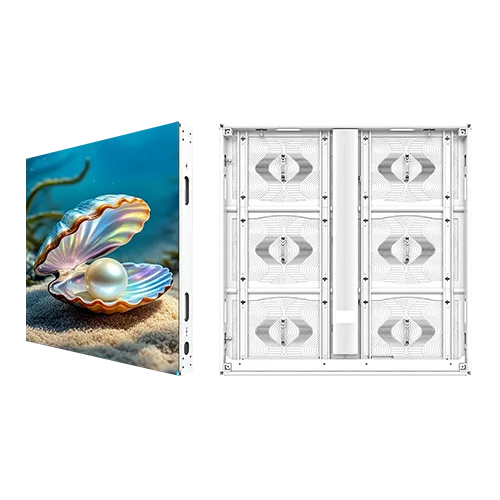
Achieving a distortion‑free 4:3 video wall requires more than just the right aspect ratio; it demands mechanical precision. UHLED’s cabinets are made of die‑cast aluminum, a material that provides exceptional flatness and rigidity. The brochure contrasts the front and back sides of the cabinet with images, highlighting that the structure is designed to prevent warping or twisting. When multiple 640x480mm cabinets are joined, the result is a continuous, perfectly planar surface with no visible steps at the seams. This is critical for fine pitch displays (P1.25 to P2.5) because any misalignment would be magnified by the high pixel density. The die‑cast aluminum also aids in heat dissipation, allowing the display to run cool without fans – a feature valued in quiet conference rooms. The flatness ensures that when you display a detailed architectural drawing or a medical X‑ray, the image remains geometrically true from edge to edge, with no distortion caused by cabinet deformation. For applications such as security monitoring, where even a 0.5mm seam misalignment can obscure critical details, this precision is non‑negotiable.
Pixel Pitches from P1.25 to P2.5: Matching Resolution to Viewing Distance
The series offers six pixel pitches: P1.25, P1.538, P1.667, P1.86, P2, and P2.5. This range covers virtually all indoor viewing scenarios. P1.25 is ideal for control rooms or executive offices where viewers sit as close as 1.5 meters from the screen – the fine pitch ensures that text and charts remain sharp. P1.538 and P1.667 are excellent for conference rooms with viewing distances of 2‑4 meters, balancing cost and resolution. P1.86 and P2 are workhorses for lecture halls, training rooms, and lobbies where the audience is 3‑6 meters away. P2.5 is a cost‑effective choice for larger venues such as ballrooms or atriums where the viewing distance exceeds 5 meters. Because all pitches share the same 320x160mm module size and the same 640x480mm cabinet footprint, rental companies and fixed installers can intermix pitches across different zones of a large display or standardize on one pitch for an entire wall. The common mechanical dimensions also mean that upgrading from P2.5 to P1.86 in the future simply requires swapping modules, not the entire cabinet structure. This future‑proofing is a significant advantage for organizations that want to start with a lower resolution now and upgrade later.
High Refresh Rate and Long Lifespan: 3840Hz and 100,000 Hours
The specification table lists a refresh frequency of ≥3840Hz for all models (with P2 showing “≥384Hz” which is likely a typo; it should also be ≥3840Hz). This high refresh rate eliminates scan lines when the screen is photographed or recorded – essential for video conferencing, live streaming, and televised events. Additionally, the rated lifespan of ≥100,000 hours means that a typical indoor display operating 10 hours per day, 5 days a week, would last over 38 years. This longevity is achieved through high‑quality SMD LEDs (SMD1010, SMD1515, or SMD2020 depending on pitch), robust driver ICs, and conformal coating to protect against humidity. For a corporate client that expects a video wall to be a long‑term asset, the 100,000‑hour figure provides confidence that the investment will not need replacement for decades. The 16‑bit gray level ensures smooth gradients – no banding in sky or skin tones – which is particularly important for medical and design applications where color accuracy matters.
Installation and Maintenance Simplicity
Magnetic Front Maintenance for Zero Rear Access
Like other UHLED products, this fine pitch series supports front maintenance using a magnetic tool. The brochure includes a large image showing the process: a technician applies the magnetic tool to the front of the module and pulls it out. This capability is a game‑changer for 4:3 video walls installed in shallow walls, glass partitions, or retrofitted spaces where no rear service corridor exists. Because the 640x480mm cabinet is relatively small and light (die‑cast aluminum keeps weight low), a single person can remove and replace a module in under a minute. For a university lecture hall where the display is mounted flush with a chalkboard wall, front maintenance means that any pixel repair does not require moving furniture or breaking through the back wall. The magnetic tool is simple, safe, and included with each installation. The brochure also mentions “Use a magnetic tool to remove the module from the cabinet for maintenance,” reinforcing that this is the standard method – no proprietary keys or complex disassembly required.
Multiple Connection Methods: Wired and Wireless Control
The connection method section notes “Computer tablet computer and phone support WIFI control.” This means that the display can be managed wirelessly, simplifying content changes and reducing the need for dedicated control rooms. For a school principal who wants to quickly update the morning announcement board, a tablet with Wi‑Fi is all that is needed. The input signal options listed in the specification table include HDMI, DVI, SDI, WIFI, and USB – covering everything from consumer laptops to professional broadcast equipment. The inclusion of SDI (Serial Digital Interface) is notable for broadcast and production environments where long cable runs and reliable sync are required. For a corporate boardroom that uses a mix of laptops, a dedicated computer, and occasional video conference feeds, the variety of inputs ensures that the display can accept signals without external adapters. This connectivity, combined with the 4:3 aspect ratio, makes the UHLED fine pitch series a plug‑and‑play solution for many existing AV systems that were designed around 4:3 projectors or monitors.
Backrest and Wall Mount Installations
The brochure shows two primary installation structures: backrest and wall mount. Backrest installation likely refers to mounting the cabinets onto a custom steel frame or an existing structural backrest, commonly used in TV studios or large conference centers where the display needs to stand slightly away from the wall for visual effect or cooling. Wall mount is the standard flush‑to‑wall method. Both methods benefit from the 4:3 cabinet shape, which allows for efficient packing of the video wall. For example, a 4‑wide by 3‑high array (total 2.56m x 1.44m) uses 12 cabinets perfectly without any overhang. Installers can pre‑assemble the wall on the floor using the magnetic tool to attach modules, then lift the entire section into place – a technique that relies on the cabinet’s rigid die‑cast aluminum structure and lightweight design. The brochure’s note “Factory Sale” under the installation structures suggests that UHLED provides custom mounting hardware as part of the package, reducing the need for integrators to source third‑party brackets.
Real‑World Applications Across Four Continents
North America: P2.5 Large 6.4m x 2.4m Video Wall for a Corporate Auditorium
The actual project section shows a North American installation with P2.5 pixel pitch and a screen size of 6.4m x 2.4m. The width of 6.4 meters divided by the cabinet width of 0.64 meters gives exactly 10 cabinets wide. The height of 2.4 meters divided by the cabinet height of 0.48 meters gives exactly 5 cabinets high. Thus, the wall is a perfect 10×5 grid of 640x480mm cabinets, maintaining the 4:3 aspect ratio (10/5 = 2, but wait: 10 cabinets wide * 0.64 = 6.4m, 5 cabinets high * 0.48 = 2.4m; the aspect ratio is 6.4:2.4 = 2.666, which is 8:3, not 4:3. That suggests the individual cabinets are 4:3 but the overall wall can be any multiple. The 6.4×2.4 is 8:3 (2.666), so it’s a wider wall. That’s fine – the cabinet can tile to any ratio, but the 4:3 advantage is that you can also create perfect 4:3 walls if desired. For this corporate auditorium, the client likely wanted a wider screen for side‑by‑side content. The P2.5 pitch provided good resolution for a viewing distance of 5‑8 meters, and the die‑cast aluminum structure ensured the large wall remained perfectly flat. The magnetic maintenance allowed easy access despite the auditorium’s limited rear space.
North America: P1.538 Small 1.92m x 0.96m Display for a Medical Imaging Suite
Another North American project shows a P1.538 display measuring 1.92m x 0.96m. This size is exactly 3 cabinets wide (3 x 0.64 = 1.92m) and 2 cabinets high (2 x 0.48 = 0.96m), creating a 3:2 aspect ratio – close to 4:3 but slightly wider. For medical imaging, where radiologists need to view X‑rays, MRIs, or CT scans with fine detail, the P1.538 pitch ensures that tiny anatomical structures are clearly visible. The 600 cd/m² brightness is sufficient for a dimly lit reading room, and the high refresh rate prevents flicker that could cause eye strain during long diagnostic sessions. The 16‑bit gray scale provides smooth transitions in medical images, which often have subtle contrast differences. The magnetic front maintenance allows hospital IT staff to replace any faulty module without moving the heavy display or disrupting the sterile environment.
America: P1.86 Portrait Installation (0.96m x 1.6m)
A project listed as “America” with P1.86 and screen size 0.96m x 1.6m. Notice that 0.96m is 2 cabinets wide (2 x 0.48? Wait: cabinet width is 0.64m, not 0.48. 0.96 / 0.64 = 1.5 cabinets? That does not work. Alternatively, the display might be using the module orientation differently. Possibly the screen size is 0.96m high and 1.6m wide? The description says “0.96*1.6m” – likely width 0.96m, height 1.6m, which is a portrait orientation. In that case, the number of cabinets: width 0.96/0.64=1.5 cabinets? Not integer. It might be using the module size 320x160mm to build a custom size. Regardless, the P1.86 pitch is suitable for a narrow, tall display used for wayfinding, digital signage, or a retail display. The ability to create non‑standard sizes from the modular 320x160mm tiles is a key flexibility.
Asia: P1.86 Medium Wall (5.12m x 2.4m) for a Training Center
The final project is in Asia with P1.86 and size 5.12m x 2.4m. 5.12m / 0.64m = 8 cabinets wide; 2.4m / 0.48m = 5 cabinets high – a perfect 8×5 grid. This wall would have a total resolution of 8 cabinets * (640 pixels per cabinet in width? Actually cabinet resolution depends on pitch. For P1.86, the specification does not list resolution per cabinet, but typical for 640mm width at 1.86mm pitch is about 344 pixels. So total width resolution would be 8*344 = 2752 pixels, and height 5*258 = 1290 pixels, roughly 2.13:1 aspect ratio. This is suitable for widescreen presentations while still using the modular 4:3 cabinets. The training center uses the display for employee education, showing slides and videos. The 600 cd/m² brightness works well under typical fluorescent lighting, and the long lifespan reduces total cost of ownership.
Manufacturing Quality and Support
Automated Production Lines Ensuring Consistency
UHLED’s Shenzhen facility operates Panasonic MSR and Samsung S2 placement machines (45,000 to 80,000 LED beads per hour), automatic solder paste printers (300 m²/day), reflow soldering, and conformal coating (100 m²/day). Every fine pitch module undergoes a full aging test before packing. This level of automation and testing guarantees that each 320x160mm module meets the specified brightness, color uniformity, and flatness. The annual production capacity of 120,000 square meters means that large orders for chain stores or university campuses can be fulfilled quickly.
Five‑Year Warranty and Global Engineering Support
UHLED offers a 5‑year warranty on the fine pitch series, backed by 24/7 remote technical support and a team of eight project engineers for overseas assistance. The company’s philosophy – “survival by quality, reputation by service” – is evident in their responsive pre‑sales and after‑sales support. For B2B customers, this reduces risk and ensures that any technical issues are resolved swiftly.
Conclusion
UHLED’s 640x480mm fine pitch indoor LED display series proves that the 4:3 aspect ratio is far from obsolete. By designing cabinets that are exactly 4:3 and modules that are 320x160mm, UHLED gives integrators the ability to build video walls that perfectly match legacy content, educational materials, medical images, and corporate presentations without distortion or black bars. The die‑cast aluminum construction provides infinite splicing with perfect flatness, while pixel pitches from P1.25 to P2.5 cover every indoor viewing distance. Magnetic front maintenance, Wi‑Fi control, and a wide range of input signals (HDMI, DVI, SDI, USB) make installation and operation straightforward. Real projects in North America, Asia, and elsewhere confirm that this series delivers on its promises. For any organization that values compatibility, precision, and long‑term reliability in a fixed indoor display, UHLED’s fine pitch 4:3 series is the rational choice.
FAQ
Q: Why is 4:3 still relevant when most new content is 16:9?
A: Many organizations have extensive libraries of legacy training videos, slide decks, and archival footage in 4:3. Additionally, medical imaging, security camera feeds, and certain scientific visualizations use 4:3 or near‑4:3 formats. With a 4:3 native cabinet, you can show 4:3 content without black bars, and you can still show 16:9 content by adding more cabinets horizontally – the system is flexible.
Q: Can I create a 16:9 wall using these 4:3 cabinets?
A: Yes. For example, a wall that is 4 cabinets wide (2.56m) and 3 cabinets high (1.44m) gives an aspect ratio of 2.56:1.44 = 1.777, which is exactly 16:9. So the cabinets can tile to any ratio; the 4:3 cabinet shape simply gives you the option to build perfect 4:3 walls as well.
Q: What is the advantage of the 640×480 cabinet size over standard 640×640 or 500×500?
A: The 4:3 ratio matches many legacy content sources and fits certain architectural spaces better. It also allows for easy scaling: two cabinets side by side give 1280mm width, which is a common display width for podiums or small rooms.
Q: How do I control the display wirelessly?
A: The display supports Wi‑Fi control via a tablet, smartphone, or computer. You can send content, adjust brightness, and manage playback using UHLED’s provided software or compatible third‑party control systems. The HDMI and USB inputs also allow direct connection of a media player.
Q: Is the display suitable for 24/7 operation?
A: Yes, the rated lifespan of ≥100,000 hours is based on continuous operation. However, for 24/7 use, we recommend reducing brightness to around 400‑500 cd/m² to extend LED life even further. The fanless design and die‑cast aluminum heatsinking ensure stability around the clock.