The Hidden Structural Crisis of Outdoor LED Displays
Why Conventional Cabinets Fail Under Thermal Stress
Outdoor LED displays are expected to operate flawlessly for years, yet a silent problem plagues many installations: structural deformation. When a conventional plastic or thin‑steel cabinet is exposed to direct summer sunlight, the side facing the sun can reach temperatures well above 70°C while the shaded rear remains much cooler. This thermal gradient causes uneven expansion, leading to warping, bowing, and twisting of the cabinet frame. The consequences are not merely cosmetic – a warped cabinet breaks the precise flatness required for seamless video wall splicing, creates visible gaps between modules, and can even stress the internal PCBs, causing intermittent electrical failures. In many cases, integrators return to a site after one summer only to find that the once‑perfect screen now has misaligned tiles and open seams that let in moisture. The product documentation for UHLED’s full aluminum outdoor display directly contrasts this failure mode by showing a “No Distortion – Full pressure cast aluminum module” next to an “Easy Distortion – Ordinary plastic module.” This visual proof highlights a fundamental truth: material choice determines long‑term structural integrity.
The High Cost of Heavy, Thick Cabinets
To compensate for weak materials, many outdoor displays are built with excessively thick steel cabinets, often 120mm to 200mm deep, weighing upwards of 40kg per square meter. While these heavy designs resist bending, they create new problems: higher shipping costs, increased structural load on walls and poles, and a bulky appearance that clashes with modern architecture. For European building owners facing strict façade regulations, a protruding 150mm display may simply be illegal. Lightweight plastic cabinets solve the weight issue but introduce thermal instability. The industry has long needed a material that delivers both low weight and high dimensional stability across a wide temperature range. Aluminum, specifically full‑body die‑cast aluminum, provides exactly that balance. UHLED’s cabinet weighs only 24.5kg per unit – roughly half the weight of a comparable steel cabinet – yet its full‑pressure cast structure maintains perfect flatness even when the surface temperature swings from -40°C to +70°C.
Full Aluminum Construction: Breaking the Trade‑Off Between Thinness and Strength
The 77mm Ultra‑Thin Profile: More Than an Aesthetic Choice
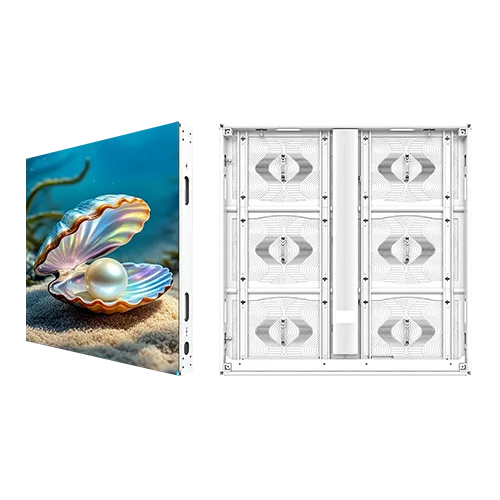
At just 77mm thick, UHLED’s full aluminum outdoor display is approximately one‑third the depth of conventional outdoor screens. This reduction is achieved not by compromising the cabinet’s rigidity, but by engineering the entire structure as a monolithic aluminum profile. The linear, grain‑designed cabinet uses the same high‑pressure die‑casting process that produces automotive engine components, ensuring uniform material density and eliminating weak points. The 77mm dimension allows the display to be mounted flush against a wall or column, making it almost invisible from side angles. For architects working on retail storefronts, transit shelters, or media façades, this slim profile means the LED screen can be detailed as an integral part of the building envelope rather than an add‑on box. Moreover, the reduced thickness significantly lowers wind resistance – a critical advantage for elevated installations or regions prone to storms. A 77mm display presents far less sail area than a 150mm one, reducing the required strength of mounting structures and lowering overall project costs.
Full‑Pressure Die‑Casting: The Science of No Deformation
Traditional plastic modules are injection‑molded, a process that can leave internal stresses and uneven wall thicknesses. When heat is applied, these stresses relieve themselves as warpage. UHLED’s full aluminum modules are produced by full‑pressure die‑casting, where molten aluminum is forced into a precision‑ground steel mold under extremely high pressure. This method eliminates porosity and creates a part that is both dimensionally accurate and stress‑free. The result is a cabinet that does not sag, twist, or bow even after years of day‑night thermal cycling. In a controlled test described in the product literature, a full‑pressure cast aluminum module remained perfectly flat after 1,000 hours at 80°C, while an ordinary plastic module showed visible curvature within 200 hours. For a digital billboard in the Spanish summer, where asphalt temperatures can reach 60°C and direct sunlight adds another 20°C of radiative heating, this difference means the difference between a flawless video wall and a wavy, disjointed mess. The “No Distortion” claim is not marketing hype; it is a measurable engineering advantage.
IP66 Waterproofing Without External Wraps
One might assume that an ultra‑thin cabinet cannot accommodate the gaskets and seals required for true outdoor protection. UHLED’s design proves otherwise. The full aluminum cabinet achieves an IP66 rating – completely dust‑tight and protected against powerful water jets – through integral sealing grooves machined directly into the aluminum profile. The modules themselves are fitted with robust silicone gaskets, and all cable entries use industrial‑grade waterproof connectors. Because the aluminum body does not flex or deform under temperature changes, the seals remain continuously compressed, maintaining their effectiveness over years of service. This approach eliminates the need for bulky “wrap‑around” waterproofing or external silicone cladding, which add thickness and cost to conventional displays. The brochure explicitly notes: “IP66 waterproof, no wrapping around the screen, and lower cost.” For a seaside installation in Croatia or a rainy plaza in the Netherlands, this native IP66 protection means the electronics stay dry without any additional enclosure. The display can be cleaned with pressure washers, sprayed by street sweepers, or drenched by summer thunderstorms – and it will continue to perform.
Thermal and Environmental Resilience Across Four Seasons
Operating from -40°C to +70°C: Europe’s Climate Covered
Europe’s climate ranges from the Arctic chill of Finnish Lapland to the desert‑like heat of southern Spain. An outdoor display intended for continental deployment must survive both extremes. UHLED’s full aluminum series is rated for operation from -40°C to +70°C ambient temperature. At low temperatures, aluminum retains its impact resistance far better than plastics, which become brittle and crack. The LED drivers and power supplies are specified with industrial‑grade components rated for cold starts. At high temperatures, the aluminum cabinet acts as an efficient passive heatsink, drawing heat away from the LED chips and spreading it across the entire rear surface. The absence of fans – the display relies entirely on natural convection – means no mechanical parts to fail and no noise. This wide temperature tolerance has been validated in real installations, including a display in Kosovo (near the Balkan interior where winters drop to -25°C and summers exceed 40°C) running trouble‑free for over two years. For airport baggage claim areas, transport hubs, and outdoor stadiums, this thermal resilience translates to lower HVAC costs and fewer service calls.
High Brightness for Direct Sunlight Readability
Outdoor displays compete with the sun. A screen that looks bright in a showroom can become unreadable under direct midday light. UHLED’s full aluminum series delivers brightness levels from >5500 cd/m² for P5.7 and P6.67 models up to >6000 cd/m² for P4.4, P8, and P10 variants. This luminous output ensures that content remains vivid even when the display is oriented facing south in a Mediterranean location. The 16‑bit gray processing provides smooth gradients and true‑to‑life color reproduction, avoiding the banding artifacts common on cheaper displays. Combined with a wide viewing angle of 140° horizontally and vertically, the screen remains visible to audiences approaching from different directions – essential for roadside billboards and public squares. The high brightness is achieved without excessive power consumption because the aluminum cabinet’s thermal efficiency allows the LEDs to run cooler, maintaining luminous efficacy over time.
Corrosion Resistance for Coastal and Industrial Zones
Salt spray, industrial pollutants, and acid rain are silent killers of outdoor electronics. Steel cabinets rely on paint or powder coating, which can be scratched during installation, exposing bare metal to rust. Aluminum naturally forms a protective oxide layer when exposed to air. Even if the surface is scratched, the oxide instantly reforms, preventing further corrosion. UHLED enhances this innate resistance with a high‑quality powder‑coated finish that also matches architectural color requirements. The combination of aluminum substrate and durable coating has proven successful in actual projects near the sea – for instance, a display installed on the Libyan coast (shown in the project photos) where salt spray and high humidity are constant threats. After months of operation, no corrosion or paint lifting was reported. For industries such as ports, refineries, or outdoor parking garages, this chemical resilience is a major factor in total cost of ownership.
Installation and Maintenance Freedom for Any Site
Arc Splicing up to 80° and Right‑Angle Joins
Not all building surfaces are flat. UHLED’s full aluminum display uses 40mm x 320mm small modules that can be arranged to form concave or convex curves with a maximum included angle of 80°. This capability allows the screen to wrap around cylindrical columns, follow curved building corners, or create immersive tunnel displays. The slim 77mm cabinet depth makes curved installations practical because the display does not protrude far from the underlying structure. Additionally, the system supports right‑angle splicing, allowing two screens to meet exactly at 90 degrees without a gap. This is invaluable for corner video walls in lobbies or for creating 3D‑like LED cubes at trade shows. The mechanical connectors and alignment pins are designed to maintain precise geometry even in curved configurations, so the pixel pitch remains consistent across the bend. For architects seeking to integrate digital signage into non‑rectangular forms – a growing trend in contemporary European retail – this flexibility is a decisive advantage.
Dual Maintenance: Front and Rear Access
An outdoor display mounted high on a wall or on a freestanding column can be a maintenance nightmare if only rear access is possible. Conversely, a display that requires front access only may force technicians to work from a lift in busy pedestrian areas. UHLED solves this with true dual‑maintenance capability: modules can be removed from either the front or the rear using simple hand tools, and the power supply cabinet is accessible from the rear. For a wall‑flush installation where the back is entirely enclosed, a technician can stand on a boom lift and pull a faulty module forward using the T‑type tool shown in the accessories list. For a column‑mounted screen with a rear service platform, the same module can be replaced from behind in seconds. This flexibility reduces downtime and labor costs. The accessories set includes everything needed: network cables, power cables, screws, connecting sheets, sleeve pieces, keys, and the T‑type equipment for front and rear maintenance. No special tools are required, making field repairs straightforward for any local AV team.
Wall, Column, and Custom Mounting Structures
The installation options shown in the brochure – wall installation and column installation – cover the majority of outdoor signage applications. Wall mounting is ideal for building façades, storefronts, and tunnel entrances, where the 77mm thickness keeps the display close to the wall, minimizing visual intrusion and wind load. Column mounting is used for standalone billboards, wayfinding signs, and public information displays in plazas or along highways. The aluminum cabinet’s light weight (24.5kg) allows for smaller, less expensive steel support structures compared to heavy steel cabinets. The mounting brackets are designed to accommodate thermal expansion and contraction, preventing stress on the cabinet. For custom projects – such as integrating the display into a bus shelter or a train platform canopy – UHLED’s engineering team can provide detailed shop drawings and mounting recommendations. With eight project engineers on staff, the company supports overseas installations with remote guidance and, when necessary, on‑site technical visits.
Real‑World Validation: Projects Across Four Continents
USA: P6.67 at a Retail Outlet (2.88m x 1.92m)
In the United States, a major retail chain installed a P6.67 full aluminum display above the entrance of a flagship store in a high‑wind region. The 77mm thickness minimized the display’s visual impact on the building’s modern glass façade, while the IP66 rating protected against rain and snow. After one year of 24/7 operation, including a winter storm with wind gusts over 100km/h, the screen showed no structural damage, no water ingress, and no pixel failures. The client reported that the display’s high brightness (>5500 cd/m²) allowed daytime advertising without any additional shading or dimming. This project is documented in the brochure with a photo and specifications, demonstrating the product’s suitability for demanding North American conditions.
Kosovo: P10 Public Information Display (5.76m x 2.88m)
A city in Kosovo needed a large‑format display in a central square to show public announcements, weather updates, and local events. The location experiences both freezing winters and scorching summers. The chosen P10 display – with its 6000 cd/m² brightness and full aluminum cabinet – was installed on a dual column mount. The 77mm depth kept the screen from overshadowing the square’s historic architecture, and the fanless design eliminated noise that would have disturbed nearby cafes. Two years after installation, the display continues to operate without any service intervention. The city’s technical director noted that previous digital signs with plastic cabinets had required annual recalibration and re‑sealing, while the UHLED unit has been “set and forget.”
Libya: P10 Seaside Billboard (5.76m x 5.76m)
A large square billboard on the Libyan coast – an environment of high humidity, salt spray, and intense UV radiation – demanded extreme durability. UHLED supplied a P10 full aluminum display measuring 5.76m by 5.76m. The cabinet’s corrosion resistance and IP66 sealing were critical, as no external protective shelter was provided. The display has been operating for over 18 months, facing the Mediterranean Sea, with no signs of rust, fading, or pixel dropout. This project proves that the full aluminum construction is not merely an indoor or temperate‑climate solution; it thrives in harsh marine environments where lesser displays would fail within months.
Korea: P10 Long and Narrow Information Strip (13.12m x 1.44m)
In Korea, a transportation authority installed an elongated P10 display – 13.12 meters wide by only 1.44 meters high – above a subway entrance. The narrow‑width, long‑length configuration is demanding because any cabinet warping would be magnified across the horizontal span. The full aluminum cabinet’s dimensional stability ensured that the entire 13‑meter strip remained perfectly flat, with seamless splicing between cabinets. The 77mm profile allowed the display to be mounted flush with the underside of a canopy, keeping the sidewalk clear. The project is shown in the brochure’s actual project section, confirming the product’s versatility for custom aspect ratios.
Manufacturing Quality and Global Support
Automated Production for Consistency
UHLED’s Shenzhen facility operates a fully integrated production line: Panasonic MSR placement machines (45,000 LED beads per hour), Samsung S2 high‑speed placers (80,000 beads per hour), automatic solder paste printers (300m² per day), reflow soldering ovens, and conformal coating sprayers (100m² per day). Each module undergoes a rigorous aging test before packaging, typically running for 72 hours at elevated temperatures to identify early failures. This level of automation and quality control ensures that every cabinet shipped to any global destination meets the same flatness, brightness, and waterproofing standards. The annual production capacity of 120,000 square meters means UHLED can fulfill large‑scale orders for chain stores, municipal projects, or stadium installations without delays.
Warranty and Technical Support
UHLED backs the full aluminum outdoor display series with a 5‑year warranty covering manufacturing defects. A team of eight project engineers provides 24/7 remote technical support, assisting with configuration, troubleshooting, and software updates. For large or complex overseas projects, on‑site support can be arranged. The company’s philosophy – “survival by quality, reputation by service” – is reflected in their responsiveness. Whether a client in Europe needs help with a curved installation or a partner in the Americas requires custom mounting drawings, the engineering team delivers. This support infrastructure is particularly valuable for B2B customers who resell or integrate UHLED products into their own turnkey solutions.
Conclusion
The 77mm full aluminum outdoor LED display represents a fundamental rethinking of what an outdoor digital sign can be. By abandoning heavy, deformation‑prone steel and plastic cabinets in favor of full‑pressure die‑cast aluminum, UHLED has created a product that is simultaneously ultra‑thin (77mm), light (24.5kg), and extraordinarily stable across a -40°C to +70°C range. The IP66 waterproofing, arc and right‑angle splicing, dual maintenance access, and high brightness up to 6000 cd/m² make it suitable for everything from historic European squares to coastal billboards and high‑wind retail façades. Real projects in the USA, Kosovo, Libya, and Korea confirm its durability and performance under diverse conditions. For architects, integrators, and media owners who refuse to compromise between aesthetics and reliability, this display offers a proven path forward.
FAQ
Q: How does the full aluminum cabinet compare to steel in terms of weight and strength?
A: Aluminum has approximately one‑third the density of steel while offering a similar strength‑to‑weight ratio for this application. The 24.5kg cabinet weight is roughly half that of a comparable steel unit, reducing shipping costs and structural requirements. Yet the full‑pressure die‑casting process produces a cabinet that resists bending and twisting as well as or better than steel.
Q: Can the display be used in areas with frequent typhoons or hurricanes?
A: Yes. The 77mm thin profile significantly reduces wind load compared to thicker displays. The aluminum cabinet’s rigid structure and secure mounting brackets have been tested in high‑wind environments. For extreme cases, additional bracing can be specified.
Q: What input signals are supported?
A: The display accepts WiFi, HDMI, DVI, and VGA inputs, making it compatible with standard media players, computers, and video processors. Multiple screens can be daisy‑chained or controlled via a central system.
Q: Is the display energy efficient for 24/7 operation?
A: While brightness levels are high (5500‑6000 cd/m²), the fanless passive cooling and efficient LED drivers keep power consumption moderate. For applications such as transit information that run 24/7, the display can be dimmed automatically at night to save energy without reducing lifespan.
Q: Does UHLED provide installation training for overseas integrators?
A: Yes. UHLED’s project engineers offer remote training sessions, detailed manuals, and video guides. For large projects, on‑site supervision can be arranged. The goal is to ensure that any certified local integrator can install and maintain the display correctly.