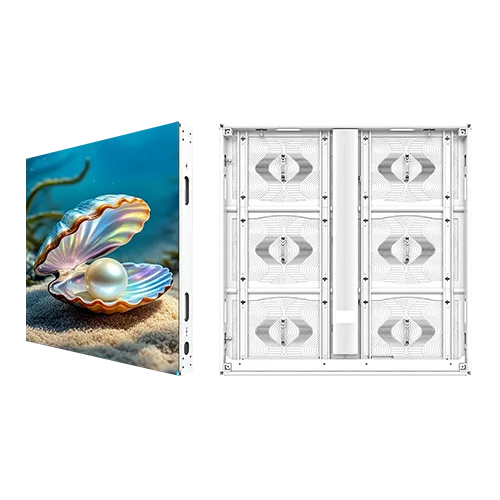
Outdoor COB LED Display
Full Flip Chip COB LED Display — P1.56 & P1.95 — IP65 Waterproof


Over the past few years, COB technology has moved from a niche offering to a mainstream choice for premium indoor displays. Industry data shows that COB now accounts for over 40% of the small-pitch LED display market, with the technology experiencing a compound annual growth rate of more than 66% through 2029.
This guide walks you through the ten most impactful applications for COB LED displays, along with the technical specifications and installation considerations you need to make an informed purchasing decision.
Before diving into specific applications, it is worth taking a moment to understand what makes COB technology different.
In a COB display, bare LED chips are placed directly onto the PCB and fixed using conductive or non-conductive adhesive. The entire assembly is then covered with an epoxy or resin layer that protects the chips from dust, moisture, and physical impact. This direct mounting approach eliminates the bonding wires found in traditional SMD designs, which in turn reduces the risk of wire breakage and improves long-term reliability.
The fundamental difference lies in packaging: COB mounts bare chips directly on the board and seals them with resin, while SMD uses individual pre-packaged components. This leads to advantages for COB in close-range image quality, durability (roughly 5x the impact resistance), and energy efficiency (under 50% power draw with common cathode). SMD, however, remains the lower-cost option upfront.
For a detailed side-by-side breakdown covering visual quality, durability, energy efficiency, and cost considerations across all pixel pitches, refer to our dedicated comparison guide: COB vs. SMD LED Display: Which One Should You Choose?
Most commercial COB displays available today offer the following performance benchmarks:
Network operations centers, security monitoring hubs, and emergency response facilities run their displays 24 hours a day, seven days a week. The operators sit close to the screen and need to read fine text, live data feeds, and surveillance grids without eye strain.
COB suits this scenario for three reasons. First, the ultra-fine pixel structure keeps small fonts legible at short distances. Second, the high contrast reduces glare under overhead lighting. Third, the sealed surface means you can wipe it down without worrying about moisture seeping into the components.
From control rooms, let us move to broadcast studios, where the demands are equally stringent but entirely visual. Camera operators hate moire patterns, and standard SMD screens often produce them when the grid of pixels interacts with the camera sensor’s sampling pattern. COB’s continuous surface minimizes this interference.
The 3,840 Hz refresh rate ensures that rolling shutter artifacts do not appear during slow pans. That is why broadcasters now routinely specify COB for their primary studio backdrops and virtual production walls.
Modern boardrooms have evolved beyond simple presentation spaces. They are now collaboration hubs, and the visual quality of the display directly influences the decisions made in those rooms. A wall that looks patchy or has visible pixel grids distracts participants and undermines the professionalism of the presentation.
COB solves this by offering a near-frameless appearance and deep black levels that make video conferencing feeds look more natural. The slim cabinet depth also allows the display to sit flush with the wall, which architects and interior designers appreciate.
Retailers are turning to COB LED displays to build stronger brand experiences in their physical stores. In high-end fashion or automotive showrooms, the display surface itself becomes part of the product story. A reflective, fragmented screen cheapens the perception; a smooth, uniform panel reinforces quality.
The resin coating makes these screens IP54-rated, so they resist dust and incidental touch. For interactive kiosks where customers browse catalogs or configure products, the protective layer holds up well to repeated contact.
Transportation environments are tough on electronics. Displays face temperature fluctuations, vibration from foot traffic, and airborne dust from braking systems. COB’s encapsulation keeps the LEDs safe from these elements.
Brightness of 800 nits or more ensures flight schedules and wayfinding maps stay readable even under the bright glass roofs of modern terminals. Maintenance teams also value the front-service design, which lets them swap modules without pulling the entire wall forward.
Cultural institutions treat display quality as a curatorial decision. If the screen distorts color or fails to reproduce dark tones accurately, the artwork suffers. COB’s 20,000:1 contrast ratio delivers true blacks, which makes video art and archival footage look closer to their original intent.
Visitors move around galleries at different angles, so the near-180-degree viewing cone ensures that a piece remains visible from the sides. The anti-glare nature of the resin surface also helps, especially in rooms with track lighting.
Event organizers face a constant trade-off between visual impact and logistical sanity. A screen that looks great but takes three days to rig is simply not practical for a one-day corporate summit. COB modules are notably lighter than comparable SMD cabinets because they use fewer structural layers.
Many units now support front-access maintenance, which means you can push the wall flat against the back wall of a ballroom and still service it. For touring productions, this translates to shorter load-in times and lower labor costs.
Live entertainment pushes displays hard. Screens get packed into trucks, set up on uneven stages, and struck down late at night. The vibration from subwoofers alone can loosen components in less robust designs. COB’s wire-bonding reduction and solid encapsulation handle this physical stress better.
The 16:9 aspect ratio cabinets commonly used for these walls also match standard broadcast formats, making it straightforward to feed live camera cuts or pre-rendered content without cropping or stretching.
A lobby is the first physical touchpoint a visitor has with your organization. That space demands a display that looks polished when turned off, not just when playing content. Black uniformity matters here: cheaper screens show mottled gray patches when idle. COB’s consistent surface and black treatment produce a clean, uniform dark panel that blends into the architecture.
The smooth face resists fingerprints and collects less dust than textured SMD surfaces, which keeps the lobby looking maintained with minimal daily effort.
Classrooms and simulation labs benefit from COB’s durability and viewing angles. Students sit off-axis in lecture halls, and instructors often point directly at the screen. The protective layer resists accidental knocks from pointers or whiteboard erasers.
For medical training or engineering visualization, where fine anatomical or CAD details must remain sharp, the high pixel density ensures that every annotation stays legible from the back row.
Modern boardrooms have evolved beyond simple presentation spaces. They are now collaboration hubs, and the visual quality of the display directly influences the decisions made in those rooms. A wall that looks patchy or has visible pixel grids distracts participants and undermines the professionalism of the presentation.

Consider a recent UHLED installation at a corporate headquarters in Chicago. The client needed a boardroom display that could handle close-range data viewing from 2–3 meters, professional video conferencing with zero glare, and all-day eye comfort for marathon meetings.
UHLED delivered a P0.93 COB LED display measuring 4.2 x 2.3625 meters. At 0.93 mm pixel pitch, the screen delivers 4500 x 2531 pixel resolution across nearly 10 square meters, allowing viewers to stand within 1 meter of the surface without perceiving individual pixels. The 3840Hz refresh rate and matte finish eliminate flicker and glare, while the 35mm ultra-thin cabinet allows the display to sit flush with the surrounding walnut paneling for a seamless, architectural finish.
For more details on this installation, including on-site photos and technical specifications, visit the full case study: UHLED P0.93 COB LED Display for Corporate Conference
When planning your installation, consider cabinet dimensions. Common formats include 600 x 337.5 mm, 640 x 480 mm, and 500 x 500 mm. The 16:9 cabinets reduce the number of scaling processors needed, since they match standard video ratios natively.
Front-service designs are now standard across most COB products. This allows hot-swapping of modules without taking the entire wall offline. However, bear in mind that if a module develops dead pixels, you cannot replace individual diodes on site. The module must be returned to the factory for re-encapsulation. Typically, manufacturers define a “dead pixel” as a cluster of three or more contiguous failures; isolated single failures are usually within tolerance and not serviceable. Factor this into your service level agreement.
COB LED display technology has matured into a reliable, high-performance solution for a wide range of professional applications. From control rooms and broadcast studios to retail environments and corporate boardrooms, the combination of superior image quality, enhanced durability, and energy efficiency makes COB an increasingly attractive choice for discerning buyers.
At UHLED, we specialize in providing high-quality COB LED display solutions tailored to the specific needs of commercial and professional environments. Contact us today to discuss your requirements, request a detailed quotation, or view case studies from our portfolio of successful installations.